In many ways Arsenal enjoyed a very good 2015/16, as they finished second in the Premier League, thus clinching qualification for the Champions League for the 19th successive season. Not only was this a place higher than the previous year, but this was also achieved by overtaking Tottenham Hotspur on the last day of the season (“and it’s 5-1 to Newcastle”).
However, given that Arsenal outperformed of all the big boys (as disgraced former England Manager Sam Allardyce used to affectionately describe them), it was still something of a disappointment to finish well behind surprise package Leicester City.
As chief executive Ivan Gazidis observed, “We have to be disappointed, certainly not satisfied, to end up second. We wanted more than that and I think that there were chances during the season. You can’t say second place is a disaster, but it’s not what we are about.”
It was a classic Arsenal case of “so near and yet so far”, so perhaps should not have been that surprising to their supporters, especially as they did not purchase a single outfield player the preceding summer.
However, it has been a different story this summer, as Arsène Wenger has addressed some of the shortcomings in his squad, splashing out £93 million to recruit Granit Xhaka, Shkodran Mustafi and Lucas Perez, who have all made contributions to a promising start.

In fact, Arsenal have quietly ramped up their spending in the last four years, averaging net spend of £49 million a season, compared to net sales of £6 million over the previous seven years. As Gazidis explained, “We are in a position that we were not in four or five years ago where we don’t have to sell our best players. We can go and sign world-class players if and when the manager identifies them.”
The chief executive pointed out that since Stan Kroenke became Arsenal’s majority shareholder, the club had actually invested around £350 million in transfer fees, including the likes of Mesut Özil and Alexis Sánchez. This is true, though fails to mention that around £160 million was recouped in the same period from player sales – and that all this expenditure was funded by the football club and not the owner.
That said, the question is whether they could have done even more. The frequent criticism of the club’s innate conservatism in the transfer market has evidently touched a nerve, as there have been a series of justifications from senior executives as to why the famous, hefty cash pile has not been fully utilised.

"Mustafi Me"
Gazidis patiently explained, “What is clear is that big spending is not the solution to all problems”, adding, “it’s not just about spending money, but about how you spend your money and doing it wisely.”
Arsenal chairman Sir Chips Keswick has clearly been given the same playbook: “We are not afraid to spend substantial sums, but it is important that the money is used wisely.”
Nobody would argue with that, but even after the increased spending it does feel as if the club is not as ambitious as it could be and it does rather bring to mind the old Hamlet quote, “the lady doth protest too much.”
Three years ago Gazidis had raised the fans’ hopes when he boasted, “We should be able to compete at a level like a club such as Bayern Munich. We can do some things which would excite you. I say that this is an extraordinarily ambitious club.”
Contrast that to this summer’s lecture: “We can't afford to outgun competitors that have far more money – we have to be very careful, very selective. That means we can’t afford to make huge mistakes in the transfer market.”

This seeming desire to play the poor relation appears strange, not least because Arsenal have actually become one of the biggest spenders in recent seasons. Since 2013 Arsenal’s net spend of £197 million is the third highest in the Premier League, only surpassed by the “unprecedented” expenditure of the two Manchester clubs, City £389 million and United £342 million, though they did splash out nearly twice as much as the Gunners.
Wenger himself has always insisted that he would have no problems spending if the right players to strengthen the squad were available, “I would spend £300 million if I find the right player – and if I have £300 million”, though he has also described the current spending levels as “quite scary”.
“Le Professeur” has further explained that English clubs suffer from having to pay a premium, as everyone knows that they are awash with money from the new TV deal, though this does make it even more perplexing that Arsenal did not spend their riches before when prices were much lower.
A couple of years ago £50 million would have bought two world-class players, while it is now barely enough for one. When Wenger was asked about the rise in transfer fees, he said, “We knew that would happen, it was not difficult to anticipate.” Well, precisely, so why keep the powder dry?

In the latest accounts for the year ended 31 May 2016, Arsenal’s cash balance has very slightly fallen by £2 million to £226 million, but the upward trend remains intact despite the higher spending. In the decade since Arsenal moved to the Emirates Stadium, cash has risen by more than 500% from £36 million to nearly a quarter of a billion.
In 2015/16 Arsenal’s cash balance has been overtaken by the cash machine that is Manchester United with £229 million, but the Gunners are far higher than the rest of the Premier League with the closest challengers in 2014/15 being Manchester City £75 million, Newcastle United £48 million and Crystal Palace £29 million.
To further place this into perspective, Arsenal’s cash balance is more than Real Madrid, Barcelona and Bayern Munich combined.

The club is very sensitive on this issue with Sir Chips Keswick even noting that it was his “duty to point out that after excluding debt service reserves (£35 million) and amounts owed to other clubs on past transfers (£42 million), the balance reduces to £149 million.”
It is also true that this figure is inflated by the seasonality of cash flows, e.g. season ticket receipts for the new season and advance sponsorship, so Arsenal’s cash balance will always be at its highest when its annual accounts are prepared. The club has to pay a good proportion of its annual running expenses out of this cash, though it is equally valid that other money will flow into the club during the course of the season, such as TV distributions, including the huge new contract, and merchandise sales.
In other words, there is still substantial money available to spend. It’s clearly not as much as the £226 million in the books, but there would be enough available in the January transfer window to further boost the squad if necessary.

Looking at Arsenal’s cash flow statement, we can clearly see evidence of a change in approach: in the six seasons between 2007 and 2012 Arsenal spent just a net £4 million on player purchases, while they have spent a net £138 million in the last four seasons.
In 2015/16 Arsenal generated an impressive £94 million from operating activities, spending a net £54 million on transfers (a new record) and £41 million on other things: £20 million on financing the Emirates Stadium (£12 million interest plus £8 million debt repayments), £13 million on capital expenditure (e.g. investment in London Colney training facilities and redevelopment of Hale End Academy) and £8 million on tax.

This is nothing new. Since 2007 Arsenal have produced a very healthy £722 million operating cash flow, though a draining £251 million has had to be used for stadium financing (£159 million on loan interest and £92 million on debt repayments) with a further £117 million on infrastructure (“hugely important investments which, whilst not grabbing headlines, will help underpin our long-term future” per Keswick) and £22 million on tax.
Only 20% (£141 million) of the available cash flow has been spent in the transfer market, though virtually all of that (£137 million) has been in the last four seasons. The other notable “use” of cash in that period is to increase the cash balance, which has risen by a cool £191 million.
Major shareholder Alisher Usmanov has noted that Wenger had been put in a very difficult position, as the shareholders did not put any money in to finance the new stadium, which meant that the quarter of a billion incurred to date on stadium financing was not available to improve the squad. That’s obviously correct, but it is equally true that Arsenal have left a lot of available money in the bank to attract one of the lowest interest rates in history, while transfer inflation has been running amok.

While on the subject of Arsenal’s cash, a recent report by CSS Investments Limited stated that Arsenal only had £4 million to spend in the transfer market (£54 million if the club made use of an overdraft facility).
This embarrassing “analysis” simply deducted all of Arsenal’s short-term net payables/receivables from Arsenal’s cash balance to produce their £4 million figure, thus assuming that the club would have zero creditors and debtors, while generating nothing from their operations during the year.
This is patently absurd, which can be easily demonstrated by applying the same approach to the other Premier League clubs. If we do that, all but four of the clubs in the top flight would have nothing to spend, as their available cash would be negative. In any case, it’s a relief that Arsenal haven’t actually gone bust, even though they spent £86 million this summer.

Arsenal duly delivered another set of solid financial results in 2015/16 with the chairman commenting, “we’ve enjoyed a season of progress both on an off the pitch”, though profit before tax fell by £15 million from £18 million to £3 million. The decrease was smaller after tax, as the tax charge was £2 million lower, but this still declined by £13 million to £2 million.
The fall in profit was despite revenue growing by £21 million (6%) from £329 million to £351 million (excluding £3 million from property development that brought total revenue to £354 million), mainly due to strong growth in broadcasting income, which rose by £16 million (13%) to £141 million. This was due to the new Champions League deal and record Premier League distributions.
This was supported by commercial income rising by £4 million (4%) to £107 million and player loans being £2 million higher at £3 million, though match day revenue dipped slightly to just under £100 million.

"The Leader"
On the other hand, profit from player sales was £27 million lower at just £2 million, while a “quiet year” for property development reduced profit from this segment by £11 million to just £2 million.
Continued investment in the squad resulted in the wage bill climbing £3 million to £195 million and player amortisation rising by £5 million to £59 million. Against that, depreciation and other expenses were £3 million lower.
Interest payable was down £6 million, though this was partly due to the implementation of accounting standard FRS 102, which meant that the prior year comparative was increased by £6 million (to reflect the change in fair value of the interest rate swap used to fix the interest rate on the floating rate stadium bonds).

Traditionally Arsenal have been one of the few profitable football clubs, but the impact of the last TV deal has helped change this with only six Premier League clubs reporting a loss in the 2014/15 season. In fact, Arsenal’s £25 million profit (before restatement) was only the 5th highest that season, behind Liverpool £60 million, Newcastle United £36 million, Burnley £35 million and Leicester City £26 million.
Only three Premier League club have so far published their 2015/16 accounts with Arsenal’s £3 million pre-tax profit being just ahead of Stoke City £2 million, but a long way behind Manchester United’s impressive £49 million.

Profit from player sales can have a major influence on a football club’s bottom line, as best shown in 2014/15 by Liverpool, whose numbers were boosted by £56 million from this activity, largely due to the sale of Luis Suarez to Barcelona. Similar large sums were made that season by Southampton £44 million, Chelsea £42 million and Tottenham £21 million.
In this way, the lack of major sales adversely impacted Arsenal’s bottom line in 2015/16. The main element in their £2 million profit was a sell-on fee for former youth player Benik Afobe’s transfer to Bournemouth.

Despite the improving profits at other clubs, Arsenal’s financial record is still one of the most consistent around with the club reporting profits 14 seasons in a row. You have to go back as far as 2002 to find the last time that they made a loss. Since then, they have made total combined profits of £278 million.
This is an astonishing achievement in the cutthroat world of football where success is very largely bought, though it is worth noting that profits have been much lower as of late. Indeed, the 2015/16 £3 million profit is the lowest in the Emirates Stadium era.
However, Arsenal’s 2014/15 profit was boosted by £29 million of player sales and £13 million from property development. In fact, over the years much of the club’s excellent financial performance has been down to profits from player sales (e.g. £65 million in 2011/12, £47 million in 2012/13) and property development (e.g. £13 million in 2010/11, £11 million in 2009/10).

These are likely be lower in future, as Arsenal no longer have to make “forced” player sales, while the property development is largely coming to an end, which means that Arsenal will be more reliant on their core business.
The chief financial officer Stuart Wiseley confirmed this view, “Improved player retention is a direct consequence of the club’s improved financial position over the last five years with a clear trend away from transfer profits as an essential component of the profit and loss account.”
There was limited activity in the property business profit in 2015/16 with profit of just £2 million. There should be money coming from the sale of the development sites at Holloway Road and Hornsey Road, though various complex agreements still need to be concluded.

To get an idea of underlying profitability, football clubs often look at EBITDA (Earnings Before Interest, Depreciation and Amortisation), as this strips out player trading and non-cash items. On this basis, Arsenal’s profitability has improved considerably in the last three seasons after many years of decline, with EBITDA rising from £25 million in 2013 to £82 million in 2016.

That’s one of the best in the Premier League (around the same level as Manchester City), but it is still over £100 million below Manchester United’s astonishing £192 million. Now that United have reduced their financing costs to a more manageable level, they basically have at least £100 million more than any other English club to spend on players – every season.

Arsenal’s revenue hardly moved at all between 2009 and 2011, but has grown by an impressive 44% (£108 million) since 2013. Most of the growth (£55 million) is down to improved TV deals, which have driven a 63% increase in broadcasting revenue, though the previously under-performing commercial division has risen by £44 million (71%), mostly due to new deals with Emirates and Puma. Match day income has also increased in that period, but only by £7 million (8%).
Despite Arsenal’s revenue rising by £21 million (6%) to £351 million, the gap to Manchester United has significantly widened to £164 million, as the Red Devils’ grew their revenue by £120 million (30%) to £515 million.
In fairness, United are in a class of their own in the Premier League, while Arsenal are now almost the same level as Manchester City (£352 million) and ahead of Chelsea (£314 million) and Liverpool (£298 million), though all these clubs are likely to increase when their 2015/16 figures are announced.

It should also be emphasised that Arsenal’s revenue is well ahead of the other English clubs: £150 million more than Tottenham (£196 million) and at least £200 million more than everybody else, including champions Leicester City, who only earned £104 million.
Clearly having more revenue is important, with Wenger stating that budget is closely correlated with success on the pitch, “The clubs who have better financial resources have the better teams”,
However, the Frenchman has also argued that it is not the be all and end all, “Manchester United is the richest club in the world, so not many teams can compete on a financial amount, but I feel that it doesn’t make any difference, because on the pitch we can compete and that is most important. Football is not a financial competition: Leicester has shown that last year.”

Arsenal stood at seventh place in the Deloitte 2015 Money League, only behind Real Madrid, Barcelona, Manchester United, Paris Saint-Germain, Bayern Munich and Manchester City, which is obviously excellent. However, there are three major challenges for Arsenal here.
(1) The leading clubs continue to grow their revenue at a faster rate, e.g. in 2015/16 Real Madrid and Barcelona increased revenue by £25 million and £31 million respectively, compared to Arsenal’s £21 million, even before their massive new kit supplier deals commence.
(2) The weakening of the Pound since the Brexit vote means that continental clubs will earn much more in Sterling terms, e.g. the 2015 Money League was converted at €1.31, while the current rate is around €1.15.
(3) The Money League highlights the increasingly competitive nature of England’s top flight with no fewer than 17 Premier League clubs in the top 30 – even before the lucrative new TV deal.

The growth in broadcasting income in 2015/16 means that this now accounts for 40% of Arsenal’s total revenue, ahead of commercial income 30%. The importance of match day income, even though it is around £100 million, has consequently diminished from 44% to 28% since 2009.
Nevertheless, Gazidis noted, “Whilst our match day revenue is now ranked behind both broadcasting and commercial as a source of income, it remains vitally important to the club and is a key differentiator to competitor clubs with smaller, less modern venues.”

This can be seen by looking at the importance of match day revenue to Premier League clubs in the 2014/15 season, where Arsenal were the only one above 30% with the nearest being Manchester United and Chelsea at 23%. In fact, no club in the Money League top 30 generates a larger proportion of its revenue from match day.
However, match day income did dip slightly by £0.5 million to £99.9 million in 2015/16. Even though Arsenal staged the same number of home games (27), the mix was different with one Champions League game less plus no involvement in the FA Cup semi-final.

This meant that Manchester United overtook Arsenal’s match day income with £107 million following their return to the Champions League. This was boosted by their average attendance of 75,000, though Arsenal’s is the second highest in England at just under 60,000.
Of course, Arsenal do have very high ticket prices, arguably the highest in the land depending on how you view the number of games included in the season ticket package.
The good news is that the club has frozen ticket prices for the 2016/17 and 2017/18 seasons, which means that ticket prices will have been held flat for nine of the 12 seasons at the Emirates Stadium with inflation-only increases in the other three years. Arsenal are also providing a further £4 discount for their away supporters attending Premier League matches in addition to the £30 cap announced by the Premier League.

Arguably, Arsenal could still do more here in light of the massive new TV deal and there is no doubt that the fans are not delighted to contribute so much money to effectively grow the club’s bank balance. As a comparison, Everton reduced season ticket prices by more than 5% this season.
Gazidis said that the board wished to “strike a balance between the expense of coming to games for our supporters and the club’s ever-increasing costs and expenditure as it develops on and off the pitch”, but he slightly ruined the effect by adding, “demand for tickets continues to far exceed supply”, reducing it to an issue of basic economics.

Arsenal’s share of the Premier League television money rose £4 million to £101 million in 2015/16, as they received a higher merit payment for finishing one place higher and received more facility fees for being broadcast live more often. This represented the highest distribution in the top flight, even ahead of champions Leicester City, as the smaller merit payment for finishing one place lower was more than offset by higher facility fees for having 12 more games broadcast live.
This is even before the increases from the mega Premier League TV deal in 2016/17. Based on the contracted 70% increase in the domestic deal and estimated 40% increase in the overseas deals, the top four clubs will receive around £150 million, i.e. around £50 million more a season.

"Beautiful Vision"
Although this is clearly great news for the clubs, it is somewhat of a double-edged sword for the elite, as it makes it more difficult (or at the very least more expensive) to persuade the mid-tier clubs to sell their talent.
As Gazidis put it, “In the past the big clubs could financially bully the smaller clubs. It would be unthinkable that a smaller club would be able to hold on to its best player if Manchester United or Arsenal came knocking at the door.” Wenger validated the new paradigm: “The clubs don’t need the money in England and maybe that’s why they only weaken if the price is high.”
Sir Chips confirmed that this was one of the reasons why Arsenal had spent more this summer: “The new broadcast revenue has provided a further competitive stimulus to the Premier League. We know that competition will be even tougher this season. Accordingly, we have made further significant investment into what was already a very competitive squad.”

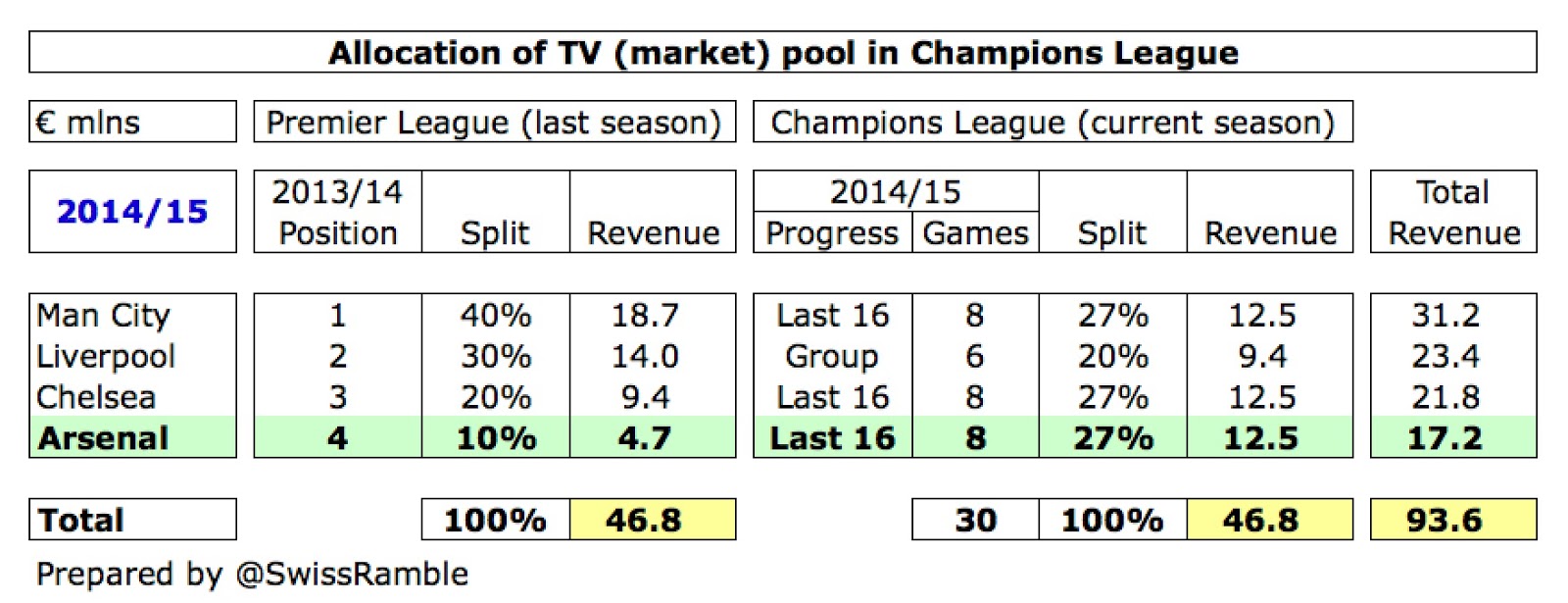
Arsenal did not announce how much they received from the Champions League, but my estimate is €51 million, up from €36 million in 2014/15, based on the increases in the 2016 to 2018 cycle, namely higher prize money plus significant growth in the TV (market) pool, thanks to BT Sports paying more than Sky/ITV for live games.

The Champions League payment is partly influenced by a club’s progress in the tournament, but it is also dependent on where it finishes in the previous season’s Premier League. In this way, Arsenal’s 2016/17 revenue will be boosted by finishing second in the 2015/16 Premier League, compared to third the year before, exacerbated by the stronger Euro exchange rate.
Wenger has played down the value of Champions League qualification to Arsenal, “What has changed over the years is that the impact of the finances in the Champions League is not as big any more. For a period in the past the money was vital to us.” That said, it is clear that it is still financially beneficial, especially if it is compared to the Europa League, where Tottenham, for example, only earned €6 million in 2014/15.

Even though Arsenal have not done that well recently, i.e. the last time that they got past the last 16 was 2010, it is still a major revenue differentiator to their domestic rivals. For example, in the five years up to 2014/15 they received €153 million, over €100 million more than Tottenham and Liverpool.

Commercial revenue increased by £4 million (4%) from £103 million to £107 million, comprising £82 million from commercial deals and £25 million from retail and licensing, largely due to new secondary partnerships.
This was a much lower growth rate than the previous two years, but the club had called this out, when announcing that both the primary partnership deals, with Emirates and Puma, are in place for the medium-term. It also pales into insignificance compared to Manchester United, whose commercial income shot up by 36% in 2015/16 to £268 million, which is an astonishing £161 million more than Arsenal.

United may be out of sight in England, but it is disappointing that Arsenal’s commercial income is still lower than Manchester City £173 million, Liverpool £116 million and Chelsea £108 million. Of course, Arsenal are in turn miles above other Premier League clubs, e.g. Tottenham £60 million, Aston Villa £28 million and Everton £26 million.

Arsenal’s commercial shortcomings can be clearly seen if we compare their revenue with the other nine clubs in the 2014/15 Money League top ten. OK, the £123 million shortfall against PSG is largely due to the French club’s “friendly” agreement with the Qatar Tourist Authority, but there are still major gaps to other clubs in commercial terms, e.g. Bayern Munich £108 million, Real Madrid £85 million and Barcelona £82 million.
Arsenal’s £150 million Emirates deal covers a 5-year extension in shirt sponsorship from 2014 to 2019 plus a 7-year extension in stadium naming rights from 2021 to 2028. The club has not divulged how much of the deal is for naming rights, so I have used the straightforward £30 million annual figure, though my own estimate would put the pure shirt sponsorship at around £26 million.

That’s pretty good, but it has since been overtaken by new sponsorship deals at Manchester United with Chevrolet (around £56 million a year at the latest USD exchange rate) and Chelsea with Yokohama Rubber (£40 million).
It’s a similar story with the Puma kit supplier deal, which is worth £30 million a year. This is one of the best kit deals around, but is still dwarfed by Manchester United’s extraordinary £75 million deal with Adidas, while Chelsea will switch to Nike for £60 million from the 2017/18 season.

At the time it was signed, United described theirs as the “largest kit manufacture sponsorship deal in sport”, though it has since been reportedly overtaken by new agreements signed by Barcelona (Nike) and Real Madrid (Adidas), which would be worth £125 million and £115 million respectively (at the current exchange rate).
Despite an increase in the number of partnerships, the concern is that Arsenal’s commercial performance will continue to place them at a competitive disadvantage relative to other leading clubs, even though owner Stan Kroenke believes that the Arsenal brand is a “big opportunity” for the club.
However, further substantial increases are only likely to come as a result of success on the pitch, which again makes you wonder why the available cash has not been spent on strengthening the squad.

Arsenal’s wage bill increased by 2% (£3 million) to £195 million in 2015/16, though the underlying growth was higher, as the prior year comparative was inflated by a double charge for Champions league qualification bonuses (August 2014 via a play-off).

However, as a result of the revenue growth, the wages to turnover ratio was cut from 58% to 56%. This is higher than the 46-50% achieved between 2008 and 2010, but is still very reasonable and is at the lower end of the Premier League.
Arsenal’s wage bill has risen by 57% (£71 million) since 2011, one of the fastest growth rates. This was justified by the CFO thus: “In light of the strong correlation between player wage expenditure and on-field success, a progressive wage bill, where growth is rational and responsible, should be regarded as a positive outcome.”

Manchester United’s high growth in 2015/16 means that their wage bill of £232 million is once again the highest in England, at least until Manchester City and Chelsea publish their accounts. Their gap to Arsenal has thus increased from £11 million to £37 million.
Of course, Arsenal’s wages are way ahead of most other Premier League clubs with the nearest challengers (in 2014/15) being Liverpool £166 million, Tottenham £101 million and Aston Villa £84 million.

Arsenal need to consider the Premier League’s Short Term Cost controls, which restrict the annual player wage cost increases to £7 million a year for the three years up to 2018/19 – except if funded by increases in revenue from sources other than Premier League broadcasting contracts.
This will be a challenge, as Arsenal soon need to extend the contracts of Özil and Sánchez. Given the limited opportunity to raise ticket prices, this again places pressure on Arsenal to grow commercial revenue.
It also helps explain Arsenal’s caution in the transfer market, as Wenger explained, “If clubs are wrong, they will have these players with high wages who cannot move anywhere else.”
What is more difficult to explain is the 15% increase in Ivan Gazidis’ remuneration from £2.299 million to £2.648 million. Nice work if you can get it.

Although there is a natural focus on wages, other expenses also account for a sizeable part of the budget at leading clubs, though Arsenal’s decreased by £2 million to £70 million in 2015/16. These cover the costs of running the stadium, staging home games, supporting the commercial partnerships, travel, medical expenses, insurance, retail costs, etc.
The good news is that Stan Kroenke’s company has waived its “entitlement” to any fee for “strategic and advisory services”, which were apparently worth £3 million the previous year.

Another cost that has had a major impact on Arsenal’s profit and loss account is player amortisation, reflecting the recent increased investment in transfers. This expense has shot up from £22 million in 2011 to £59 million in 2016.

As a reminder of how this works, transfer fees are not fully expensed in the year a player is purchased, but the cost is written-off evenly over the length of the player’s contract. As an example, Özil was reportedly bought for £42.5 million on a five-year deal, so the annual amortisation in the accounts for him is £8.5million.

However, Arsenal's player amortisation is still by no means the largest in the Premier League. Those clubs that are regarded as big spenders logically have the highest amortisation charges, e.g. Manchester City £70 million and Chelsea £69 million in 2014/15, while Manchester United’s cheque-book strategy since Sir Alex left has driven their annual amortisation up to an incredible £88 million in 2015/16.
There have been a few misguided reports in the media that Arsenal have paid off their stadium debt, but the reality is that the debt incurred for the Emirates development continues to have an influence over Arsenal’s strategy.

Although this has come down significantly from the £411 million peak in 2008 to £233 million, it is still a heavy burden, requiring an annual payment of around £20 million, covering interest and repayment of the principal. Arsenal’s debt comprises long-term bonds that represent the “mortgage” on the stadium £194 million, derivatives £24 million and debentures held by supporters £14 million.

The interest payable of £13 million is more than twice as much as any other Premier League club (£5-6 million at Sunderland, West Ham, Manchester City and Tottenham) – with the notable exception of Manchester United, even though they reduced this to £20 million in 2015/16.

Although the net debt stands at only £6 million, thanks to those large cash balances, the gross debt of £233 million remains the second highest in the Premier League, only behind Manchester United, whose borrowings rose to £490 million, largely due to the impact of unfavourable exchange rate movements on the USD denominated debt.
Apart from financial debt, it is worth noting that Arsenal also owe a net £42 million to other football clubs for transfers, though this is down from £66 million the previous year, and have spent more than £90 million on new players since the financial year-end.

"The patience of a Santi"
Even though some other clubs are still well ahead financially, Arsenal are still better placed than most. Gazidis, for one, is bullish: “We are in a strong position to continue moving forward at every level of the club. Our ultimate ambition is clear: to win major trophies and make Arsenal fans at home and around the world proud of this great club.”
That sounds a lot better than Stan Kroenke’s throwaway comment that “If you want to win championships, then you would never get involved”, which hardly inspires confidence that the board is committed to maximising the club’s chances of competing at the top level.

"Come on, Alex, there's nothing to it"
It would be a fitting tribute to Wenger’s 20-year anniversary at Arsenal to go one step better than last season by winning the Premier League again, but the competition this year looks stronger with City resurgent under Guardiola, and United, Liverpool, Chelsea and Tottenham all looking to bounce back from their various misfortunes.
Unfortunately, Arsenal failed to invest their available cash when this would have gone a lot further, which very much feels like a missed opportunity. Obviously, spending big is in itself no guarantee of winning trophies, but it does tend to give a club its best chance of success.
However, this summer Arsenal did start to act like a big club, finally recognising the new realities of the transfer market. Allied to exciting Academy products like Alex Iwobi and Hector Bellerin, this gives cause for quiet optimism for the future, though it’s still too early to say whether this team will deliver.
However, this summer Arsenal did start to act like a big club, finally recognising the new realities of the transfer market. Allied to exciting Academy products like Alex Iwobi and Hector Bellerin, this gives cause for quiet optimism for the future, though it’s still too early to say whether this team will deliver.