• This is default featured slide 1 title

    Go to Blogger edit html and find these sentences.Now replace these sentences with your own descriptions.This theme is Bloggerized by Lasantha Bandara - Premiumbloggertemplates.com.

  • This is default featured slide 2 title

    Go to Blogger edit html and find these sentences.Now replace these sentences with your own descriptions.This theme is Bloggerized by Lasantha Bandara - Premiumbloggertemplates.com.

  • This is default featured slide 3 title

    Go to Blogger edit html and find these sentences.Now replace these sentences with your own descriptions.This theme is Bloggerized by Lasantha Bandara - Premiumbloggertemplates.com.

  • This is default featured slide 4 title

    Go to Blogger edit html and find these sentences.Now replace these sentences with your own descriptions.This theme is Bloggerized by Lasantha Bandara - Premiumbloggertemplates.com.

  • This is default featured slide 5 title

    Go to Blogger edit html and find these sentences.Now replace these sentences with your own descriptions.This theme is Bloggerized by Lasantha Bandara - Premiumbloggertemplates.com.

Showing posts with label Leicester City. Show all posts

Tuesday, March 29, 2016

Leicester City - Sweet Dreams (Are Made Of This)


The story of the season is undoubtedly Leicester City. The Foxes spent five months at the bottom of the Premier League last year before an amazing resurgence that included seven wins in their last nine games that took them to safety in a respectable 14th place. However, it is fair to say that nobody predicted that they would be leading the table with every chance of winning the title.

Their success is all the more extraordinary, given that they changed manager in the summer, bringing in Claudio Ranieri after Nigel Pearson was dismissed for a series of what might be loosely termed as “PR misdemeanours”. Although a popular figure, Ranieri’s appointment was widely ridiculed, despite his solid track record at clubs like Valencia and Chelsea, though it looks like the Italian will have the last laugh after a season that the club itself has described as “remarkable”.

That description is spot on, given that Leicester were in League One, the third tier of English football, as recently as 2009, and they were only promoted to the Premier League in 2014 (after a 10-year absence from the top flight).

It’s been a long journey back, though the seeds of improvement were sown in August 2010 when the current Thai owners, King Power International and the Srivaddhanapraba family, bought the club from Milan Mandaric for £39 million.

"Keep the party going"

There is no doubt that Leicester’s success has been largely built on the ongoing support from the owners, whose wealth comes from having an effective monopoly in duty-free rights at all airports in Thailand. According to the club, this meant implementing “a significantly enhanced football strategy to challenge for promotion as well as significantly in the infrastructure of the club.”

In plain English, the owners followed a strategy of funding hefty losses in the Championship in order to gain promotion as soon as possible to the Premier League (with all its associated riches). That might sound all too simple, but it’s easier said than done, as supporters of Nottingham Forest and Derby County (among others) would surely testify.

In particular, Leicester’s owners have exhibited a winning blend of patience in continuing to finance the club even after a series of frustrating near-misses, but also the requisite degree of ruthlessness, as shown by the dismissals of Paulo Sousa, with the team “not gelling” under his leadership, and Sven Goran Eriksson, who was fired after failing to achieve promotion and an inconsistent start to the following season.

The owners have certainly put their money where their mouth is, most evidently by converting over £100 million of outstanding loans into equity and purchasing the stadium from Teachers, an American pension fund manager. These were rightly described as “momentous gestures of their commitment” by chief executive, Susan Whelan, as they have dramatically improved the club’s financial security.

"Happy talk"

It is now hard to believe that Leicester City went into administration in 2002 with debts of £30 million, following the collapse of ITV Digital and after incurring substantial costs for building the new stadium, and had to be effectively bailed out by its fans.

The club’s ambitions are altogether different these days. Indeed, following promotion to the Premier League in 2014, chairman Vichai Srivaddhanapraba outlined his plans for Leicester to reach the top five. He said: "It will take a huge amount of money, possibly £180m, to get there. That doesn't put us off. I am asking for three years, and we'll be there.”

At the time, that looked like a ridiculous statement, but the reality is that his club has achieved this objective in less time and after spending significantly less money.

"Wes One (shine on me)"

In fact, Leicester’s performance off the pitch has been every bit as good as that on the pitch, as seen by the 2014/15 accounts, which revealed record revenue of £104 million and a pre-tax profit of £26 million. After adding a tax credit of £5 million, the profit after tax was even higher at £31 million. Unsurprisingly, the club called this “the most successful financial year in the club’s recent history.”

The previous season in the Championship produced a loss of £21 million, so the year-on-year improvement was a massive £47 million. As Whelan put it, “Promotion to the Premier League and the subsequent retention of that status in May 2015 has transformed the financial performance of the club.”

Revenue more than tripled from £31 million to £104 million with the vast majority of the £73 million growth coming from the much higher TV deal in the Premier League, which was worth an additional £68 million.


Match receipts also rose £3.7 million (53%) from £7.0 million to £10.7 million, as “the effect of Premier League status drove attendances.” Similarly, commercial income was £1.5 million (8%) higher at £20.1 million, as the club’s fan base grew.

As would be expected in the top flight, the wage bill increased by £21 million (58%) from £36 million to £57 million, reflecting new signings and contract extensions for a number of key players, though in context this growth still merited the club’s assessment of “prudent cost control”.

Player amortisation also rose by £4 million to £7 million, while profit on player sales was £1 million lower. Depreciation and other expenses were £3 million higher.

On the other hand, net interest payable was reduced by £2.5 million from £4.1 million to £1.6 million following the conversion of all outstanding shareholder loans into share capital.


As a sign of Leicester’s progress, their profit before tax of £26 million is the second highest reported to date for the 2014/15 season, only surpassed by Liverpool’s £60 million, but ahead of Arsenal £25 million and Southampton £15 million.

Even though the Premier League these days is a largely profitable environment with only four clubs losing money so far in 2014/15, thanks to the increasing TV deals allied with Financial Fair Play (FFP), it is still possible for clubs to lose a lot of money in the top flight. Just ask Aston Villa, who posted a £28 million deficit.


That said, it is far from unusual for Premier League clubs to report lower profits in the second year of the television deal’s three-year cycle, as there are limited possibilities for revenue growth, while wage bills continue to grow apace. In fact, half of the clubs that have announced 2014/15 figures have reported lower profits, which makes Leicester’s £47 million growth all the more impressive, though in fairness most of this was driven by the single event of promotion.


What is impressive is that hardly any of Leicester’s profit (only £135k) came from player sales, as these can have a major influence on a football club’s bottom line, especially at Liverpool, whose numbers were boosted by £56 million from this activity in 2014/15, largely due to the sale of Luis Suarez to Barcelona.

In the same way, Arsenal and Southampton, the closest challengers in the profit league to Leicester, would actually have reported losses without the benefit of once-off profits from player sales (£29 million and £44 million respectively).


The transformational impact of promotion is underlined by the 2015 profit being the first that Leicester have made since 2006. In the four previous seasons following the King Power takeover, the club had aggregate losses of around £100 million. In other words, the owners absorbed average losses of £25 million a year to fund promotion.

On the one hand, some might look unfavourably on this as a form of financial “doping”; on the other hand, the owners should be praised for not reducing their spending when things did not go immediately to plan.


Football clubs often subsidise underlying losses by selling players, but that has not been the case at Leicester, as they have only made a total of £12 million profit from this activity in the last decade. Uncharitably, this might be considered as a sign that they had nobody worth buying, but the main reason is that they have retained players to build a squad that could make a challenge, initially in the Championship, then in the Premier League.

It will be interesting to see if that remains the case now that their talent has effectively been in the shop window all season.


Even though Leicester have not been prolific in this area, it is worth exploring how football clubs account for transfers, given that it can have such a major impact on reported profits. The fundamental point is that when a club purchases a player the costs are spread over a few years, but any profit made from selling players is immediately booked to the accounts.

So, when a club buys a player, it does not show the full transfer fee in the accounts in that year, but writes-down the cost (evenly) over the length of the player’s contract. To illustrate how this works, if Leicester were to pay £10 million for a new player with a five-year contract, the annual expense would only be £2 million (£10 million divided by 5 years) in player amortisation (on top of wages).

However, when that player is sold, the club reports the profit as sales proceeds less any remaining value in the accounts. In our example, if the player were to be sold three years later for £15 million, the cash profit would be £5 million (£15 million less £10 million), but the accounting profit would be much higher at £11 million, as the club would have already booked £6 million of amortisation (3 years at £2 million).


Notwithstanding the accounting treatment, basically the more that a club spends on buying players, the higher its player amortisation. Thus, Leicester’s player amortisation more than doubled from £3.2 million to £7.3 million following promotion in 2014, reflecting the purchases of Leo Ulloa, Danny Simpson and Tom Lawrence. It should be even higher next year, as this figure does not include last summer’s relatively high spending.

Leicester also booked an impairment charge of £5.2 million in 2012/13, as the directors considered the value of some players to be lower than that in the accounts, which was one of the reasons that Leicester reported a record loss of £34 million that season.


Impairment reduces player amortisation charges in future years, which therefore has the impact of improving profitability going forward. It was clearly a good idea for Leicester to do this in 2012/13, as the Football League implemented the Championship FFP rules the following season.

Despite the 2015 increase, Leicester’s player amortisation of £7 million is still one of the lowest in the Premier League, only ahead of West Bromwich Albion and Burnley. Of course, it is way behind the really big spenders like Manchester United, whose massive outlay under Moyes and van Gaal has driven their annual expense up to £100 million, Manchester City £70 million and Chelsea £69 million, but it is also lower than the likes of Crystal Palace £11 million and Stoke City £12 million.


The other side of the player trading coin is player values, which shot up from £5.5 million to £23.2 million in 2015, partly due to an increase in the squad size from 25 to 34. This will further rise next year following this season’s expenditure.

Interestingly, Leicester are one of the few clubs that provide a directors’ assessment of the market value of their players. This now stands at £64.6 million or £41.4 million more than the value in the books, which would roughly equate to the potential profit from player sales.


As a result of all this accounting fancy footwork, clubs often look at EBITDA (Earnings Before Interest, Depreciation and Amortisation) for a better idea of underlying profitability. After many years of negative EBITDA, Leicester’s has risen to an impressive £38 million in 2015.


This is actually the fifth best in the Premier League, only behind four clubs with substantially higher revenue-generating capacity, namely Manchester United £120 million, Manchester City £83 million, Liverpool £73 million and Arsenal £63 million. This is evidence of Leicester’s ability to control their costs and goes a long way towards explaining their profitability.


Leicester have come a long way since their one season in League One, not least in terms of revenue, which has increased from just £11 million in 2009 to £104 million. Clearly, most of this “exponential” revenue growth is down to promotion to the Premier League, where it is indeed a whole new ball game, but there was also a strong increase in the promotion season itself, largely due to the “groundbreaking 5-year international marketing and licencing deal with Trestellar Limited”.

Any other growth in the Championship was basically due to success on the pitch, e.g. for reaching the play-offs in 2010 and 2013 or the run to the sixth round of the FA Cup in 2012. In addition, £0.8 million was generated in 2012 from a lucrative pre-season friendly with Real Madrid.

Even after the explosive revenue growth in 2015, Leicester’s £104 million is still only the 12th highest in the Premier League, so theoretically they should not be able to compete with the financial might of the elite clubs, who earn at least £200 million more than them: Manchester United £395 million, Manchester City £352 million, Arsenal £329 million, Chelsea £314 million and Liverpool £298 million.


Perhaps a more relevant (Midlands) comparison would be Aston Villa, who earn £12 million more than Leicester, but have performed woefully. In their very different ways, both clubs have shown this season that money is not the sole indicator of success.

In fact, the growing TV money in the Premier League has produced a much more even playing field with many of the so-called mid-tier clubs proving a considerable threat this season. The relative increase in wealth compared to other countries means that it is now easier to bring in higher quality players.

Although the leading English clubs still have a major financial advantage over clubs like Leicester, a combination of limits on squad size and FFP restrictions means that they cannot sign all the quality players available.

This phenomenon was noted by no less an authority than Arsène Wenger: “The Leicester example will happen more and more. Because the English clubs will get £100 million from television next year, they can buy anywhere in the world what they want. So I think the fact that the league will be more level is a necessity.”


To back-up this assertion, Leicester made their debut in the Money League last season in 24th place, along with Crystal Palace and West Brom. As Deloitte observed, “This is again testament to the phenomenal broadcast success of the English Premier League and the relative equality of its distributions, giving its non-Champions League clubs particularly a considerable advantage internationally.”

That’s obviously a fine accomplishment, but it does not really help Leicester domestically, as no fewer than 17 Premier League clubs feature in the top 30 clubs worldwide by revenue.

Nevertheless, Leicester now generate more revenue than famous clubs like Napoli, Valencia, Seville, Hamburg, Stuttgart, Lazio, Fiorentina, Marseille, Lyon, Ajax, PSV Eindhoven, Porto, Benfica and Celtic.


The vast majority (71%) of Leicester’s revenue in the Premier League came from television with just 19% from commercial income and 10% from gate receipts. This was very different to the mix in the Championship with commercial leading the way with 60%, followed by match day 22% and broadcasting 18%.

In 2014/15 Leicester’s share of the Premier League TV money was £71.6 million, compared to just £4.2 million in the Championship (£1.9 million from the Football League pool and a £2.3 million solidarity payment from the Premier League).

The distribution of these funds is based on a fairly equitable methodology with the top club (Chelsea) receiving £99 million, while the bottom club (QPR) got £65 million. Most of the money is allocated equally to each club, which means 50% of the domestic rights (£22.0 million in 2014/15), 100% of the overseas rights (£27.8 million) and 100% of the commercial revenue (£4.4 million).


However, merit payments (25% of domestic rights) are worth £1.2 million per place in the league table and facility fees (25% of domestic rights) depend on how many times each club is broadcast live. This means that Leicester will receive significantly more money this season (probably around £90 million), as they will finish much higher in the league and have been shown live many more times than the eight games in 2014/15.

As the club accounts state, “the new Premier League TV deal will increase once again significantly” in 2016/17. My estimates suggest that a top four place would receive an additional £50 million under the new contract, so, if Leicester could repeat their fine efforts next season, their TV revenue would rise to around £140 million.


If that sounds good, their revenue will get another major boost if they qualify for the Champions League. This was worth an average of €39 million to the four English clubs in 2014/15 in TV money alone, excluding additional gate receipts and higher sponsorship deals.

In fact, this understates the potential revenue, as the new Champions League TV deal that started this season is worth an additional 40-50% for participation bonuses and prize money with further significant growth in the market pool thanks to BT Sports paying more than Sky/ITV for live games.


It is also worth noting the importance of the TV (market) pool to the Champions League distributions. Half of the payment depends on how far a club progresses in the Champions League, but the other half is based on where the club finished in the previous season’s Premier League, so if Leicester do manage to win the league, they would get a 40% share of that element (2nd 30%, 3rd 20%, 4th 10%).

Match receipts climbed by 53% (£3.7 million) from £7.0 million to £10.7 million in 2014/15, thanks mainly to the average attendance rising from 25,003 to 31,697. Ticket prices also rose by around 3%, which was not too bad after promotion to the Premier League, though there were obviously four fewer home matches in the top flight.


Other clubs have hiked prices by much more in such circumstances, but Susan Whelan outlined the club’s ticketing approach, namely “to reward those fans that have been loyal to us, to make supporting Leicester City more accessible to everyone and to fill the King Power Stadium on a regular basis.”

In this way, Leicester’s match receipts of £10.7 million are among the lowest in the Premier League, around the same level as Crystal Palace. Their cheapest season ticket is the third cheapest in the Premier League, contributing to the stadium being filled to 98.5% of its capacity.


Furthermore, the club froze ticket prices for the 2015/16 season. As a result of this approach, Leicester sold out its 23,000 season tickets. Club ambassador Alan Birchenall commented: “The stadium is fantastic, it’s always full of noisy fans and the atmosphere is brilliant.”

Leicester’s average league attendance of around 32,000 was the 12th highest in the Premier League, just behind Aston Villa. Not only does this compare very favourably with other clubs, but it has actually grown by over 9,000 (40%) in the last two seasons.


To be fair, Leicester have always been very well supported, with the third highest attendance in the Championship in the promotion season. They also managed to attract over 20,000 in League One.

Given the club’s upward trajectory, there has been some talk about extending the stadium capacity to 41,000 by adding a new tier to the East and Family Stands, though there appear to be no immediate plans to do so. Importantly, Leicester at least have this option now after the owners purchased the stadium.


Commercial revenue rose £1.5 million (8%) from £18.6 million to £20.1 million in 2014/15. Although a long way below clubs like Manchester United £197 million and Manchester City £173 million, this is above clubs like Sunderland £17 million, Stoke City £15 million, Crystal Palace £12 million and Southampton £11 million.

Leicester attributed the rise to the marketing and licencing deal with Trestellar Limited, which had already driven a substantial increase in commercial income in 2013/14 from £5.2 million to £16.1 million. There has been a fair amount of scepticism about this deal, largely due to the fact that Trestellar was a hitherto unknown tiny company located on an industrial estate in Sheffield.

"Born to run"

The accusation is that the 2014 increase in revenue conveniently allowed Leicester to meet its Financial Fair Play targets in the Championship, thus evading a transfer embargo or fine, but the club is adamant that it is above board: “This deal allows the club to exploit and monetise its unique brand in both the traditional UK market and even more excitingly the Far East where the club’s ownership and profile allow it to generate exceptional growth.”

Trestellar does seem a somewhat unlikely choice as the club’s marketing partner, though its directors do include the son of Sir Dave Richards, the former chairman of the Premier League. Its abbreviated accounts do not reveal much, though its retained profit increased by £800k in 2015, implying that it did make a profit even after the payment to Leicester, while its cash balance rose by £4.2 million.


The deal was further explained in Leicester’s 2015 accounts: “King Power entered into sponsorship agreements with Trestellar Limited in relation to the acquisition of sponsorship and marketing inventory including the front of shirt sponsorship and the stadium naming rights.”

Previously, media reports, including the respected SportingIntelligence website, had estimated the annual value of the King Power shirt sponsorship as £1 million, making it one of the smallest in the Premier League.

In May 2015 Leicester extended the multi-year kit supplier deal with Puma, but the terms were undisclosed.


As might have been predicted, Leicester’s wage bill rose by £21 million (58%) from £31 million to £57 million following promotion, due to the increase in the size of the squad, the higher level of remuneration payable to players in the Premier League and several players signing new contracts.

However, the wages to turnover ratio fell significantly from 117% to 55%, one of the lowest (best) in the Premier League. To place that into perspective, Aston Villa’s ratio was considerably higher at 75%, despite higher revenue.


Very sensibly, Leicester have implemented “a strategy of performance-related pay whereby salary costs will fluctuate in line with income generated and on-field performance.” In this way, the 2015 figures included £5-6 million for avoiding relegation, while the 2014 wages were inflated by a £9.4 million promotion bonus.


That said, Leicester’s wage bill of £55 million was still one of the lowest in the Premier League, only above Hull City and Burnley in 2014/15. This makes their feats this year all the more astonishing, especially when you compare the wages at the leading clubs: Chelsea £216 million, Manchester United £203 million, Manchester City £194 million and Arsenal £192 million.

Some clubs manage to punch above their weight, but the scale of Leicester's outperformance of their wage bill this season has been truly astonishing, given the historic correlation between wages and league position.


However, the story was very different in the Championship, as explained by Susan Whelan: “The club’s strategy of investing in a strong squad to fight for a promotion place has led to increases in staff costs.” You can say that again, as the wage bill rocketed up from £14.5 million to £36.3 million in that division.

In fact, in 2013/14 Leicester benefited from the second highest wage bill in the Championship, only behind QPR’s ridiculous numbers. Even after excluding the bonus payment, the net figure of £27 million was still among the highest with those clubs paying more having the benefit of parachute payments (which Leicester did not).


On the other hand, Leicester have not spent excessively in the transfer market, making good use of free transfers, such as Esteban Cambiasso and Matty Upson, while their highly effective scouting network, led by head of recruitment Steve Walsh, has found some hidden gems for incredibly low fees, including Jamie Vardy (Fleetwood Town), Riyad Mahrez (Le Havre) and N’Golo Kante (Caen).

Since their return to the top flight, Leicester have obviously increased their expenditure, splashing out £55 million (£49 million net) in the last two seasons. Some of this is on younger players with an eye to the future, e.g. Demarai Gray from Birmingham City and Daniel Amartey from FC Copenhagen.
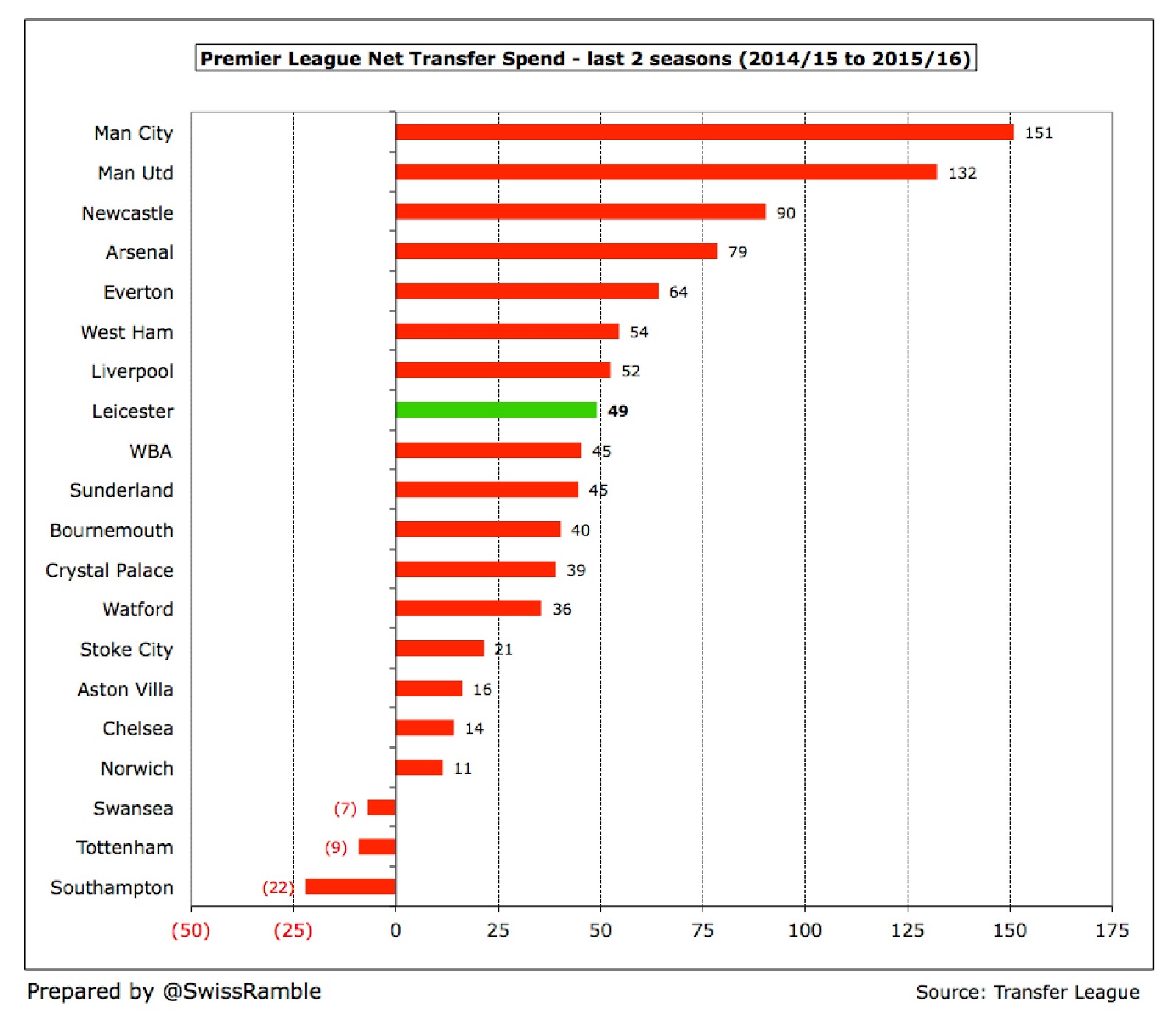

What’s more, Leicester’s net spend in this period is actually the eighth highest in the Premier League, just behind Liverpool £52 million and West Ham £54 million, which might surprise a few people. Obviously, it’s still miles behind Manchester City £151 million and Manchester United £132 million, but it’s a fair old chunk of cash.

Net debt fell by £4.3 million from £19.0 million to £14.7 million with gross debt rising £1.5 million from £27.4 million to £28.9 million, more than offset by cash climbing by £5.8 million from £8.4 million to £14.2 million. Note: the debt figure reported in the club accounts is £8.8 million lower, as it excludes loans owed to group companies fro some reason.


In any case, the key point here is that virtually all of the outstanding debt is owed to the parent company: £19.9 million in finance leases taken over when the stadium was purchased and £8.8 million for accrued management fees, interest and travel costs.

Moreover, Leicester’s debt has been significantly cut following the conversion of £103.4 million of shareholder loans into equity in November 2013. This comprised around £77 million of loans from King Power plus £26 million inherited from the Mandaric era.

As the club put it, this was “the biggest step towards self-sufficiency in recent memory”, adding that it has “strengthened the clubs balance sheet and ensures the historic interest charge in the accounts is removed.” Not only that, but it also allowed Leicester to make an £8 million FFP loss – the maximum permitted under the Championship FFP rules.


In addition, Leicester had £8.8 million of net transfer liabilities, up from £0.9 million the previous season, while the net impact of player purchases and sales after the accounts closed is £33.7 million.

Leicester’s financial debt of £29 million is now one of the smallest in the Premier League, just behind Aston Villa £31 million, and much less than Manchester United, who still have £444 million of borrowings even after all the Glazers’ various re-financings, and Arsenal, whose £232 million debt effectively comprises the “mortgage” on the Emirates stadium.


Given the club’s current financial strength, some have observed that it would a magnificent gesture if it could now settle some of the debts owed to local businesses when the club went into administration.

As a result of the debt conversion, Leicester’s interest payable has been steadily reducing, from £7.2 million in 2013 to £1.6 million in 2015. As a comparison of what might have been with a different kind of overseas owner, Manchester United incurred £35 million of interest costs last season as the price of their leveraged buy-out.


The cash flow statement further underlines Leicester’s improvement. After many years of cash losses, in 2014/15 they generated an impressive £29 million from operating activities, allowing a substantial increase in expenditure on player registrations and infrastructure. In addition, there was no need for additional owner funding last season.

In the previous four years, the owners had to put in £80 million. Little wonder that Whelan praised the Srivaddhanapraba family for their “remarkable support”. However, the strategy must have always been for the club to stand on its own feet as soon as possible.


Unlike some other overseas owners, Leicester’s cannot be accused of hoarding cash. While they have a healthy balance of £14 million, this is much less than Arsenal £228 million and Manchester United £156 million.

The only potential blot on the horizon is Financial Fair Play. Although Leicester clearly have no issues in the Premier League, their 2013/14 submission has still not been accepted by the Football League.

According to the club, it has “submitted a compliant FFP return in relation to the 2013/14 season. The Football league has subsequently requested certain clarifications which have been provided. The Directors are confident that the club has complied with the regulations and that no material liability will arise from this process.”

"Something in the water"

On the face of it, Leicester should be fine, even though their accounting loss of £20.8 million was above the maximum permitted of £8 million, as they could exclude exempt expenditure such as the promotion bonus (£9.4 million) and Academy costs. However, the Football League is clearly investigating the substance of the Trestellar marketing deal.

If the decision goes against Leicester, they would face a fine, according to a tariff which increases in line with the amount of the overspend, but this would clearly not be as much of a problem now that Leicester have the riches in the Premier League. The Football League would only comment, “The League and Leicester City remain in an ongoing dialogue.”

Whatever the outcome, it probably should not detract from the overall feel good factor in the narrative. As Whelan said, their efforts over the last few seasons have “put Leicester City in a very strong position to move forward. Our commitment to delivering success on a continuous basis is foremost in our planning.”

"You can't handle the Huth"

Much will depend on the club’s ability to hang on to its talent. Marc Albrighton, the energetic winger, acknowledged that players like Vardy, Mahrez and Kante would be wanted men, but gave a good argument for them staying: “Their dream must be to play for one of the biggest teams in Europe, as every player’s is, but why would you want to leave this club at the moment? It's building something special. We are establishing ourselves as a top-four team and they are a massive part of this.”

His view is backed-up from a financial perspective, as there is no longer any compelling need for clubs like Leicester to sell their prize assets. In particular, Leicester will see a significant increase in revenue, based initially on their Premier League success this season, then the new TV deal in 2016/17 plus big money from the Champions League.

For those keen to see a club break through the glass ceiling, Leicester have been a breath of fresh air this season. It’s impossible to say whether Leicester will be a one-hit wonder, but they have certainly demonstrated the ambition for consistent success, both on and off the pitch. To paraphrase the mighty Neil Young, “Long may they run.”
Share:

Wednesday, March 23, 2011

All Change At Leicester City


Leicester City’s home defeat against Portsmouth on Saturday might not have definitively ended their hopes of securing a Championship play-off place, but it has certainly put another nail in the coffin. The recruitment of Sven-Göran Eriksson initially looked like a masterstroke, as the Swede inspired a dramatic improvement in the team’s fortunes, including a run of seven wins and one draw after the turn of the year, but Leicester’s surge up the table has virtually ground to a halt in March. However, few leagues are more competitive than the Championship and while there’s life, there’s hope, particularly as the Foxes are still only five points away from featuring in the end-of-season play-offs.

Although Sven’s reputation has been somewhat tarnished in recent times, not least by the miserable experience as director of football at Notts County, the recruitment of a manager with such international pedigree (Benfica, Lazio, Manchester City among others) still represents something of a coup for the East Midlands club. The Swede’s reputation has helped tempt a number of familiar faces into joining Leicester’s promotion challenge, including former England international Darius Vassell and a veritable army of other players on loan, including Nigerian powerhouse Yakubu.

Of course, such an influx of new players can be a double-edged sword: on the one hand, it can improve the quality of the squad, but on the other hand too many changes are difficult to quickly absorb. Despite the fact that every politician now routinely places change at the forefront of his manifesto, it’s not that easy to put into practice, which might help explain Leicester’s current struggles.

"Yak attack"

At least the funding for the new players is an impressive show of commitment from the club’s new Thai owners, Vichai Raksriaksorn and his 25-year-old son Aiyawatt, known as Top, who lead the consortium that bought the club from Milan Mandaric last August. Vichai is estimated to be worth around £115 million, which apparently ranks him 27th on the Forbes list of the richest men in Thailand, but it is Aiyawatt who runs the club on a day-to-day basis. The source of the family’s wealth is the King Power duty free business, which has the monopoly on retail business at Bangkok Airport and signed a three-year shirt sponsorship deal with Leicester just a week before the takeover.

So far, so good, but many fans were uncomfortable with the lack of transparency around the deal, including minor details like how much money the club had been sold for, who exactly had bought the club and what had happened to the club’s debts. In fairness, many of the questions have now been answered with the accounts revealing that 100% of the club was sold to Asia Football Investments including the assignment of all shareholder loans, with the ultimate owner being Vichai through his company K Power Sports Limited (based in the British Virgin Isles). Moreover, the Football League finally ratified the change in ownership in October under their new (presumably more stringent) regulations.

However, the new owners’ objectives are still not crystal clear, at least to this observer. Indeed, in November, Leicester City revealed that there was, in fact, a second major shareholder, namely Cronus Sports Management, owned by Iman Arif, an Indonesian businessman who is prominent in the Asian mining industry and is also a member of the Indonesian Football Federation, which now has 20% of the club’s shares. The remaining 80% stake remains with Asia Football Investments. Of course, the amended ownership structure does not imply any Machiavellian manoeuvres, but it might encourage the detractors to raise a quizzical eyebrow. At least Leicester’s chief executive, Lee Hoos, is a believer, describing the new owners as “the real deal”, and, to be fair, they have certainly put their money where their mouth is to date.

"Meet the new bosses"

Doubts about the motives of the new investors may seem overly cynical, but when it comes to football clubs, the motto is surely, “once bitten, twice shy.” In particular, Leicester City fans don’t have to look too far for empty promises, as Milan Mandaric promised to “take the Foxes back to top flight football” when he came to the club in February 2007, but instead presided over Leicester’s first ever season in the third tier of English football, when they were relegated to League One in 2007/08.

Although Mandaric is clearly a very charismatic individual with an ability to inspire supporters with his ambition and visions of success, his achievements have not always matched up to the fine rhetoric. He often spoke of bringing financial stability to Leicester City, overlooking the inconvenient fact that the club recorded large losses in every single year of his tenure, while spending all of the turnover and more on the wage bill. To his credit, he personally covered Leicester’s funding and has underwritten the club’s losses, but it is difficult to get the specifics on exactly how much money he put into the club.

Certainly, when Mandaric first approached Leicester, his bid was deemed unsatisfactory by several shareholders with one claiming that it did not have “a hope in hell” of succeeding. The highly regarded David Conn of the Guardian suggested that he paid no more than £600,000 for his shares, though he pledged to invest a further £9 million into the club. Importantly, however, he did guarantee debts of around £20 million, including £17 million owed to the US finance company Teachers for the financing of the construction of the Walkers Stadium.

"Put your hands up for Milan"

The man himself said that he “will have failed”, if Leicester were not “in the Premiership in three years”, but being criticised for missing that optimistic target is perhaps a trifle harsh. It is however entirely reasonable to challenge his assertion that “when I leave, the club will be in far better shape than it is now.” Here, the report card is fairly damning: the club is still mid-table in the Championship, while the losses and debts have grown.

Chief executive Lee Hoos begs to differ, arguing that Mandaric should primarily be applauded for bringing new investors to the table. With its undertones of Macbeth, “Nothing in his life became him like the leaving of it”, this is faint praise indeed and raises the awful spectre of Mandaric’s departure from Portsmouth, where the new owners did not exactly work out too well for the south coast club.

At least the auditors have given Leicester’s accounts a clean bill of health for the last two years, which was not the case in 2007/08, when they included the dreaded “Emphasis of Matter” statement, ominously warning, “The financial statements have been prepared on a going concern basis and the validity of this depends on the directors being able to obtain additional funds from the ultimate controlling party to enable the company to continue in business.” To put it simply, there was a risk that Leicester City would go bust, unless the owners stumped up the cash, so Mandaric’s commitment to “stand by the club” was important for its survival.

"No Turkish delight for Darius Vassell"

Long-suffering Foxes fans are no strangers to seeing their club hit financial difficulties, as the club entered administration in October 2002 following relegation from the Premier League, when they were hit by a perfect storm of debts arising from the construction of a new stadium, the collapse of ITV Digital and a high wage bill. The club only escaped from insolvency four months later when ex-player Gary Lineker and a group of local businessmen bought them for £5 million, but creditors received just 10p in the pound, including HM Revenue and Customs, who had to write-off more than £6 million of the outstanding tax bill.

Leicester’s cause has not been helped by the managerial merry-go-round taking place at the Walkers Stadium, despite the 2005 accounts stating, “The appointment of a manager is arguably the most important decision a football can make.” If that were indeed the case, you’d think that they would take a little more care when making such decisions. Incredibly, Eriksson is the fifteenth manager Leicester have had since 2004, though I may have lost count, and is the ninth appointment since Mandaric took the reins. Maybe the board thinks that practice makes perfect, but that has not prevented them appointing some real duds, such as Gary Megson (9 games) and Martin Allen (4 games).

The last two departures beggar belief. Nigel Pearson, the best manager Leicester have had since Martin O’Neill, guided the team back to the Championship and nearly got them promoted to the Premier League the very next season, but his reward for these magnificent efforts was to be effectively forced out of the club. His replacement, Paulo Sousa was sacked after just nine games in charge, the day after Mandaric insisted that his manager should be given more time. Richard Bevan, the chief executive of the League Managers’ Association, complained, “How can a chairman expect to deliver success at a football club when a talented manager is recruited and dismissed within two months?”

"Making plans for Nigel"

Apart from the unnecessary cost of paying compensation for all these managerial ch-ch-ch-ch-changes (© David Bowie), there is the additional expense of continually having to bring in new players that suit the incoming manager’s tactics, while the consequent lack of stability is hardly conducive to success on the pitch. It takes time to transform a team’s playing style, but Leicester have not been willing to grant their managers that luxury.

It’s not so long ago since Leicester enjoyed some success. After being promoted to the Premier League in 1996 under O’Neill, they finished in the top ten four years in succession and also won the League Cup twice, which meant qualification for Europe. However, things have gone downhill since the departure of the man from Northern Ireland. Peter Taylor’s ill-fated reign is remembered for some truly abysmal transfer purchases, including the dreadful striking partnership of Ade Akinbiyi (£5.5 million) and Trevor Benjamin (£1 million).

After the club was duly relegated in 2002, Micky Adams somehow managed to get the Foxes straight back up, but it was a Pyrrhic victory, as the club did not have the means to survive at the highest level, so they only lasted a solitary season before immediately dropping back down to the Championship in 2004.

"Andy King - Prince of Wales"

Thus, Leicester have been excluded from the riches of the Premier League for seven seasons, though it was a case of “so near, so far” last year, as they finished fifth in the Championship and only lost on penalties to Cardiff in the play-off semi-final. Having got so close, most people must have thought that this would have been the perfect time to build on the season’s efforts. Instead, Mandaric opted to drive Pearson away, before recruiting a completely different manager, Sousa, who decided that he would replace many of the stars with untried foreign players with predictably bad results, bringing us neatly to Sven’s turn to throw the dice.

Despite the fact that so many of the club’s actions are seemingly designed to undermine the team’s performance, the stated objective is still promotion to the Premier League. Last year, this was expressed in a more balanced fashion: “Returning the club to a position of financial and operational stability matched by a sustainable football model that will in turn springboard the club to Premiership status.”

Since then, the strategy would appear to have been modified in favour of gambling on attaining that elusive position in the Premier League, because “retaining a strong football squad to fight for a promotion place limited the amount of sensible cost reduction we could enforce.” Translation: we’re going to over-spend on wages in the hope that the (theoretically) better players will drag us over the finishing line. This has been exacerbated by the flood of loan players, though, to be fair, Leicester are far from alone in pursuing such a policy, as the size of the prize is so vast. It also paid off a couple of years ago when the club bounced back from League One, assisted by a relatively high wage bill (for that division).

Although Mandaric said that his aim was “to return Leicester City to a self-sustaining business”, the harsh reality is that the club’s current business model is almost certain to produce losses, unless they: (a) manage to sell a player for serious money; or (b) gain promotion to the Premier League. The last time that the club made a profit (£1.7 million) was in 2005/06, when its revenue was boosted by the final parachute payment of £6.5 million following relegation from the Premiership.

Since then, Leicester’s total losses for the last four years add up to a frightening £33 million, including the club’s record deficit of £14.2 million in 2007/08, though this was impacted by £4 million of exceptional charges (£3 million for goodwill impairment following the acquisition of the club in 2003 and £1 million for management restructuring).

Last year’s loss of £7.5 million was £1.3 million higher than the previous year, even though the revenue rose nearly 50% from £10.9 million to £16.2 million, as wages increased by £3.3 million to £14.5 million and the profit on player sales fell £2.5 million to £1.4 million. Once again, chief executive Lee Hoos re-iterated the strategy, “Coming on the back of a promotion-winning season in 2008/09, these figures reflect our attempts to capitalise on the momentum generated by our immediate return to the Championship.”

"Richie Wellens shows his battling spirit"

New vice-chairman Aiyawatt Raksriaksorn hinted at a new ethos, “Of course, we don’t want to write off losses every year. We will try to make it break even first. That is the target. Then we will look to make a profit.” Sounds good, but the chances are that the losses will get worse before they get better, as the club spends the additional funding provided by the Thais on bringing in new players, further driving up the wage bill.

To be fair to Leicester (and other clubs of their ilk), they have to spend to remain competitive in the Championship, especially as the revenue at clubs that are relegated from the Premier League is effectively boosted twice, first by the substantial funds they receive while in the top tier, second by the parachute payments. In this way, the Premier League really is the gift that keeps on giving – or at least for another four years, as teams receive a total of £48 million in parachute payments following relegation (£16 million in each of the first two years, £8 million in each of years three and four).

Let’s take Burnley, one of the sides competing with Leicester for a play-off place. Last season, the Clarets’ revenue of £45 million was significantly higher than Leicester’s £16 million, almost entirely due to the difference in broadcasting income (£34 million compared to £5 million), as the revenue from gate receipts and commercial activities was near enough the same. Following relegation to the Championship, Burnley’s projected revenue will still be much more than Leicester, purely due to the £16 million parachute payments. That’s hardly a level playing field, so begins to justify Leicester’s apparently suicidal financial strategy.

This is why people refer to the Championship play-off final as one of the most lucrative matches in world football with the value estimated at £90 million. Even if the promoted club came straight back down, it would receive £40 million TV income plus £48 million parachute payments plus additional gate receipts and commercial revenue. Of course, if it finished higher in the Premier League, the club would receive even more TV money and every season survived adds another £40 million to the coffers. It’s incredible to think that just one place in the football pyramid can make such a difference.

In truth, the financial gap between the Premier League and the Championship continues to grow, which is why clubs are so desperate to reach the promised land of the top division. Of course, it is still possible to do this without risking the financial health of the club, but it’s not easy and many are not willing to patiently wait for players to be developed and a successful team to be built.

The television money in the Championship is mainly sourced from the Football League central distribution of £2.5 million that is made to all clubs, which was increased last season, plus a £1 million solidarity payment from the Premier League. The latter funding was introduced in 2007/08, but it doesn’t really make any meaningful impression on the revenue gap between the two leagues.

Gate receipts increased from £4.5 million to £5.7 million last season, following the return to the Championship, which saw an 18% increase in the average attendance from 20,253 to 23,943, and additional income from reaching the play-offs. This is an impressive demonstration of the fans’ support for their club, especially attracting more than 20,000 in League One, and highlights Leicester’s potential. In fact, the average crowds last year were higher than five Premier League clubs (Fulham, Bolton, Burnley, Portsmouth and Wigan).

"Kyle Naughton - loan star"

This year, the attendances have held up, despite the tough economic environment, averaging 23,623 after 17 matches, which is the fourth highest in the Championship. This was partly due to an early bird scheme for season ticket renewals, which is being repeated this season with a small price increase of £1 per game. Not a huge amount, but I can’t help noting that the new owners had pledged not to raise ticket prices.

The club moved away from Filbert Street in 2002 to the Walkers Stadium, a spanking new 32,500 all-seater stadium. Former shirt sponsors Walkers, the Leicestershire based crisp manufacturers, signed a ten-year deal for naming rights that same year, and the agreement was renegotiated in 2007, when they again paid a “seven-figure sum” to extend the deal until 2017. The new owners have spoken of their desire to rename the ground as the King Power Stadium, but it is not yet clear whether Walkers would be willing to walk away. They have also talked about plans to increase the capacity by nearly a third to 42,000 if they secure promotion.

Arguably, the Walkers Stadium is already Premier League standard, but this is actually a burden at the moment. Lee Hoos explained the problem, “It is difficult in the Championship, because it is a very expensive infrastructure here at the Walkers Stadium and the training ground. It isn’t cheap to operate and what is an asset in the Premier League is a hindrance in the Championship.” Mandaric went further, “Anywhere but in the Premier League, this stadium is a liability financially, because we have a £17m debt that has to be serviced.”

"The theatre of crisps"

Back in 2005, the club announced in its accounts that it was “committed to further expanding its commercial activities”, but this has proved to be easier said than done: retail and merchandising revenue is effectively unchanged (£1.5 million in 2005 and £1.6 million in 2010), while sponsorship and advertising has hardly grown (from £2.5 million to £2.9 million). Income from conferences, banqueting and catering has actually decreased from £3.3 million to £0.9 million, though this is partly due to outsourcing catering to Compass in 2008.

As of this season, the shirts are sponsored by King Power, the owners’ company, in a deal running three years, though no financial details have been divulged. Similarly, there is a new three-year kit deal with Swiss firm BURRDA. Again, no news on revenue, but the club did describe it as “the biggest in Leicester City’s history.”

The new owners have outlined their vision of taking the club to a global market, building on their experience in retail marketing. In fact, one of Sven-Göran Eriksson’s first tasks as Leicester manager was to take the team to play a friendly in Bangkok against the Thai national side. However, it is far from certain that Leicester’s new Asian connections will automatically raise their profile in the Far East. A leading Thai journalist at the Bangkok Post, Wanchai Rujawongsanti, argued, “I don’t think they would be able to become a popular side in Asia. Fans in this part of the world are only crazy about top Premier League sides such as Manchester United, Liverpool, Chelsea and Arsenal.”

On the cost side, the wage bill is the key factor. Wages rose almost 30% last season from £11.2 million to £14.5 million, reflecting the promotion to the Championship. This was exactly the same as the wage bill the last time they were in that division two years ago in 2008 and is actually less than the £17 million they paid out in 2005, so it’s not as if their spending is out of control. The problem is that their revenue is low and has decreased after the loss of the parachute payment, so the important wages to turnover ratio is still of concern. Although this has come down from the high of 103%, it still stands at 89%, which is considerably above UEFA’s recommended maximum limit of 70%., and may well worsen this season, as a result of the new players recruited first by Sousa, then Eriksson.

Even though Leicester have spent relatively big on wages, the same accusation cannot really be leveled at the club with regard to the transfer market. In fact, in the last eight years their net spend has been only £3 million. Even this represents an increase on previous years, when the Foxes made good money from player sales, moving on the likes of Emil Heskey, Neil Lennon and Gary Rowett.

These days, the club’s sights have been lowered, so few big money purchases are made, but equally little money has been received when transferring players. The most expensive signing last summer was Martyn Waghorn from Sunderland at just £3 million, while Sven’s costliest acquisition to date is the uncompromising defender Sol Bamba from Hibernian for a fee of £250,000.

That said, Leicester’s net spend of £2 million over the last two seasons amazingly still leaves them among the highest spenders in the Championship with only seven clubs paying out more. There are three reasons for this apparent anomaly. The first two are fairly obvious: one is that the clubs in the Championship are strapped for cash; the second is that half the clubs in that league have simply sold more players than they have bought.

The other reason for the low spend is more interesting, namely that the use of the loan system has shot up in the Championship this season. Championship rules allow clubs to take up to six players on loan at a time and to include up to five of them in an 18-man match day squad. However, the main driver of the growth is the Premier League’s introduction of a 25-man limit in the size of the squad. Players aged 21 and under are not included in the cap, so logically clubs have taken on more quality young players.

They need playing time, so Premier League clubs are now more willing to loan players, even funding some of the wages during the loan period. This is particularly relevant for leading clubs, who have allowed many of their players to go out on loan to the Championship: Tottenham 9, Arsenal 7, Chelsea 7, Manchester City 7, Manchester United 5 and Liverpool 3.

Many clubs have taken advantage of this trend, few more so than Leicester who have taken an incredible 12 players on loan so far this season, only surpassed by Sheffield United. Some of the more experienced professionals like Roman Bednar, Curtis Davies and Chris Kirkland have failed to make an impact at the lower level, but promising youngsters like Kyle Naughton (from Spurs), Jeffrey Bruma (Chelsea) and Ben Mee (Manchester City) have cemented their places in Leicester’s defence.

However, it is the eye-opening loan signings of international strikers Yakubu (from Everton) and Diomansy Kamara (from Fulham) that really signals the intent of Leicester’s new Thai owners. Although they have not yet provided the funds for any major permanent signings, all these loan players have not come cheap. While some of the wages will no doubt be subsidised by their Premier League employers, this must be having a detrimental effect on Leicester’s wage bill, which the owners have to cover. Yes, some of the loan stars are youngsters, whose salaries are probably not that high, but the sheer quantity of loan players is likely to have greatly increased the club’s costs.

Indeed, the latest accounts specifically mention that since the books closed the new owners have injected a further £10.85 million of working capital into the business by way of parent company loans. This is on top of the £29.5 million net debt reported as at 31 May 2010, so the current borrowings probably amount to over £40 million – or a worrying 2.5 times the club’s annual turnover. In fairness, very little is owed to the banks, as £22 million of this comes from the owners.

The terms of the new loan from the Thais are unknown, but the previous parent company loans of £11 million which they took on are unsecured and non-interest bearing. They are repayable on demand, though Asia Football Investments confirmed that they would not seek repayment of these loans within 12 months of the date of signing the accounts if such payment would prejudice the ability of the club to settle its other obligations, so there is some comfort there.

The other substantial debt of £17 million is connected to the building of the stadium, which is the subject of a hire purchase contract. Interestingly, the repayment terms depend on which division of the football league the club plays in, so presumably promotion to the Premier League would imply higher annual charges. There are also £1.6 million other third party loans, which attract interest at 1.23%, and £0.4 million bank loans, secured on the club’s property, with interest payable at 1.75% above the bank base rate.

The chairman of the Football League, Greg Clarke, who ironically was chairman at Leicester City when the Foxes went into administration with large debts, has warned of the dangers facing clubs, “Debt's the biggest problem. If I had to list the 10 things about football that keep me awake at night, it would be debt one to 10. The level of debt is absolutely unsustainable. We are heading for the precipice and we will get there quicker than people think.” Sobering stuff from a man who has been there, seen the sights and bought the t-shirt.

"La Bamba"

Even so, Leicester’s balance sheet looks reasonably healthy at first glance with net assets of £5 million, but that is largely due to the £41 million value ascribed to the stadium, based on a revaluation performed in 2009. On closer inspection, for amounts falling due within one year, the net current liabilities stand at £21 million, excluding the £10.85 million loans made since the accounts were published.

Of course, the net book value of the players, considered as intangible assets in accounting circles, is significantly under-stated at £3 million, as they are worth significantly more in the real world with the directors’ market valuation of the squad being £16 million. The only problem is that in order to realise that value, the club would have to sell the players, which would leave a few gaps in Sven’s formation.

The fact is that Leicester continue to require funding from the owners to pay for their strategy, as can be seen from the cash flow statement. Large cash outflows have been financed by money from share capital payments and increased borrowing, which has amounted to £20 million in the last four years and is now up to £31 million with the addition of the latest £10.85 million loan.

The issue was neatly encapsulated in the latest accounts: “The directors have determined that whilst the business could continue to operate without obtaining significant additional monies, the achievement of the objective to secure a return to the premiership will require additional funding.” That’s fine from a financial perspective, so long as your wealthy owner continues to pump money in, but nobody has bottomless pockets and Vichai Raksriaksorn has already complained that the consortium has had to invest more than they thought when they bought the club.

The “sugar daddy” model is one that has come to be accepted by football fans everywhere, but it does carry risks if the benefactor one day decides to exit stage left, which could happen for a plethora of reasons. As a pertinent example, the last time a Thai took over an English football club it ended in tears, when Thaksin Shinawatra, the exiled former Thai prime minister, sold Manchester City only a year after he arrived, having fallen out with a certain Sven-Göran Eriksson.

Clearly, not all Thai investors are cut from the same cloth, but a reasonable question might be whether Leicester’s new owners have the wherewithal to fund their dream of getting the club into the Premier League. The £115 million that Raksriaksorn is reportedly worth might be a fortune to the likes of you and me, but it’s debatable whether it’s enough to cover many years of losses at a football club in an era when billionaires are the entrepreneur of choice.

"Diomansy - maybe not forever"

That might explain a growing trend whereby foreign businessmen are increasingly looking to invest in Championship clubs, as they can buy them more cheaply than Premier League clubs, hoping to secure a larger return by funding a promotion to the top flight.

Either way, it’s difficult to fully understand what the owners’ intentions are for Leicester’s future. Chief executive Lee Hoos is convinced that this is a long-term project, “They said they are not here for one year, two or three, they are here for the long run. This is about long-term sustainability for the club.”

On top of that, Mandaric proclaimed that the deal would “strengthen the squad and youth academy by bringing additional financial support and introducing a new global network of contacts and access to player talent”, but Vichai has admitted that the goal of his consortium is “to build Thailand as a football academy for Asia in the future.” A noble objective, for sure, but it’s not clear exactly what implications this might have for the Foxes.

Leicester City is clearly a club with a lot of potential, which is what has attracted the new owners and indeed Eriksson, who commented, “The target for this club is to reach the Premier League, hopefully this year. If not this year, then next year. I think the ambition of the club is fantastic. If they did not have that ambition, then I would not be interested.” And there lies the crux of the matter: what will happen if Leicester are not promoted in the next two years? Will Sven stick around? Will the Thais be happy to cover the inevitable losses if Leicester remain in the Championship?

"Yuki Abe - Leicester's turning Japanese"

As Mandaric once said, “There is no money in football unless you are in the Premier League”, which is why Leicester (and others) try to spend their way to the top. However, this is a risky strategy, as only three teams will be promoted each season. No club has a divine right to be in the top tier, though Leicester are undeniably better equipped than most, as Sven explained, “I think they have everything here: the stadium, the training ground and the fans. There is everything to be a Premier League club. It’s only the table which doesn’t look very good.”

And that’s the point – the team still needs to do the business on the pitch. While promotion might look like a long shot right now, there will be many twists and turns in the dog-eat-dog Championship before the play-off places are decided. If Leicester’s exciting new signings do manage to gel under Sven’s shrewd guidance, then they might just fulfill the dreams of the new owners – and indeed the legions of fans that have followed them through thick and thin.

Share:

Labels

Blog Archive

Recent Posts

Unordered List

Theme Support