• This is default featured slide 1 title

    Go to Blogger edit html and find these sentences.Now replace these sentences with your own descriptions.This theme is Bloggerized by Lasantha Bandara - Premiumbloggertemplates.com.

  • This is default featured slide 2 title

    Go to Blogger edit html and find these sentences.Now replace these sentences with your own descriptions.This theme is Bloggerized by Lasantha Bandara - Premiumbloggertemplates.com.

  • This is default featured slide 3 title

    Go to Blogger edit html and find these sentences.Now replace these sentences with your own descriptions.This theme is Bloggerized by Lasantha Bandara - Premiumbloggertemplates.com.

  • This is default featured slide 4 title

    Go to Blogger edit html and find these sentences.Now replace these sentences with your own descriptions.This theme is Bloggerized by Lasantha Bandara - Premiumbloggertemplates.com.

  • This is default featured slide 5 title

    Go to Blogger edit html and find these sentences.Now replace these sentences with your own descriptions.This theme is Bloggerized by Lasantha Bandara - Premiumbloggertemplates.com.

Showing posts with label Tesla. Show all posts

Friday, August 10, 2018

The Privatization of Tesla: Stray Tweet or Game Changing News

After my last two posts in Tesla, I was planning to take a break from the company, since I had said everything that I had to say about the company. In short, I argued that Tesla, notwithstanding its growth potential, was over valued and that to deliver on this potential, it would need to raise significant amounts of capital in the next few years. In an even earlier post, I described Tesla as the ultimate story stock, both blessed and cursed by having Elon Musk as a CEO, a visionary with a self destructive streak.  Even by Musk's own standards, his tweet on August 7 that Tesla would be going private, adding both a price ($420) and a postscript (that funding had been secured), was a blockbuster, pushung the stock price up more than 10% for the day. The questions that have followed have been wide ranging, from whether Tesla is a good candidate for  "going private" to the mechanics of how it will do so (about funding and structure) to the legality of conveying a market-moving news story in a tweet. 

1. Public to Private - The Why
When we talk about transitions between private and public market places, we generally tend to focus on private companies going public. That is because it is natural and common for a small, privately owned business, as it grows larger, to move to public markets, with an initial public offering. That said, there are publicly traded companies that seem to move in reverse and go back to being privately run businesses, as Tesla may be proposing to do. 

The Trade Off
To understand both transitions, the more-common private to public and the less-frequent public to private, let us consider the trade off between being a private business and a publicly traded company, from the perspective of the business:
Private versus Public: Business Perspective

The simple summary is that as a private company's need to access capital increases, it will accept more information disclosure and a more outsider-driven corporate governance structure, and make the transition to being a public company.  In recent years, the market for private equity has broadened and become deeper, allowing companies to stay private for far longer; Uber, for instance, is worth tens of billions of dollars and is still a private company. To fully understand the transitions, though,  we also have to look at the choice from the perspective of investors:
Private versus Public: Investor Perspective
In the classic structure of going public, private firms raise money from venture capitalists who accept less liquidity, but structure their equity investments to often get more protection and a bigger say in how the company is run. It is the desire for liquidity that makes venture capitalists push private companies to go public, so that they can cash out their investments. To be able to negotiate better disclosure and control, private company investors have to be investing larger amounts, and it is one reason that regulatory authorities have been wary of allowing small investors to invest in private companies, since they may end up with the worst of all worlds: illiquid investments in businesses, where they have no say in how the company is run, and no information about how well or badly it is doing.

The Public to Private Transition
With this trade off in mind, why would a public company choose to go back to being a private business? This transition makes sense if a company feels that the easier access to capital and a continuously set market price (which delivers liquidity), two features of public markets, no longer provide it with sufficient benefits, and/or the costs of disclosure and outsider intervention (from activist investors), that also come with being a public company, increase. In short, it has to be a company:
  • that does not need access to large amounts of new capital to continue operating,
  • where the market is under pricing the company, relative to its intrinsic value ,
  • that feels the actions that it needs to take in its best long term interests will either create public backlash (layoffs and plant closures) or adverse market reactions (because of the effect that they will have on metrics that investors are focused upon).
It should come as no surprise that most companies that have gone through the public-to-private transition have been aging companies (no growth, no capital needed), trading at prices that are below their peer group (lower multiples of earnings or cash flows) and that need to shrink or slim down to keep operating.

The Tesla Case
As I look at the list of criteria for a good buyout company, I see nothing that would bring Tesla onto my radar as a potential candidate:
  1. It is a growing company and it needs new capital to not only deliver on its growth promise but to survive for the next few years. If you are more optimistic than I am about Tesla, you may disagree with how much cash the company will have to raise to keep going, but I challenge even the most hardened optimist to tell me how the company will be able to increase production to a million cars or more without investing mind blowing amounts in new capacity.
  2. If markets are punishing Tesla by under pricing the company, they are doing so in a very strange manner, giving it a higher market capitalization than much larger, more profitable automobile companies, ignoring large losses and generally tolerant of Elon Musk's errant behavior. In fact, if the critique of markets is that they are short term and focused on profits, Tesla would be the perfect counter example.
  3. It is true that there was substantial drama and market volatility around the 5000 cars/week production target, and there may be some in the company who have the drawn the lesson that since there will be more production targets to come in the future, the company needs to operate out of market scrutiny. That would be the wrong lesson, since almost all of the drama in this episode, from setting the target (5000 cars/week) to the constant tweets about whether the targets would be met, was generated by Elon Musk, not the market. In fact, a cynic would argue that by focusing the market's attention on this short term target, Tesla has been able to avoid answering much bigger questions about its operations.
There are, of course, the short sellers in Tesla and Musk's frustration with them was clearly a driver of his "going private" tweet. His argument, which many of his supporters buy into, is that short sellers in public markets make money from seeing stock prices go down, and that some of them may do real damage to companies, because of this incentive. I will not dismiss this complaint, but I will come back to it later in this post, since I do think it is playing an outsized role in this process.

Public to Private - The Funding
When you decide to take a publicly traded company into the privately owned space, you have to replace the public capital (public equity and debt) with new capital that can be either private equity or new debt. 

The key questions then become what mix of debt and equity to use, how to raise the private equity needed to get the deal done and what the ultimate end game is in the transaction. Specifically, you may take a company private, because you want to control its destiny fully, and keep tit a private business in perpetuity. More often, though, the end game is to make the changes that you think will make the company more attractive to investors, and either take it back public or sell it to another public company.

The Analysis
If the company in question fits the buyout mold, i.e., it is an aging company with a lower market capitalization, relative to earnings and cash flows, than its peers, the going private transaction can be funded with a high proportion of debt, explaining why so many buyouts have leverage attached to them, making them leveraged buyouts. 

Given that the equity investors in the transactions have to give up public market governance tools, it should come as no surprise that in many of these deals, the private equity comes from a single firm, like KKR or Blackstone, with top managers holding some of the private equity, to align interests, after the deal goes through. Success in these deals comes from taking the reconfigured company public again, at a much higher value, leaving equity investors with outsized gains.

The Tesla Case
Tesla is a money-losing company, burning through significant amounts of cash. Not only is the company in no position to borrow more, I have argued before that it should not even carry the debt that it does. If this deal is to make sense, it has to be predominantly equity funded, but that does create some challenges. 
1. The No-pain solution: Musk, in his Tuesday tweets, seems to offer a solution, which, if feasible, would be relatively painless. In his set up, existing shareholders will be allowed to exchange their shares in Tesla, the public company, for shares in Tesla, the private business, and those shareholders who are unwilling to take this offer will sell their shares back to the company at $420/share. In the extreme case, where every existing shareholder takes this offer and if existing debt holders are willing to continue to lend to the new private enterprise, Tesla will need no new funding:

This would be magical, if you can pull it off, but there are two significant impediments. The first is that the deal may not pass legal muster, since the SEC restricts private companies to having less than 2000 shareholders, and Tesla has far more than that number. It is true that you might be able to create a fund that has individual shareholders, which then holds equity in the private company, like Uber has, but that fund is restricted to very wealthy, big investors, and the SEC may be unwilling to go along with a structure where there are thousands of small stockholders in the fund. The second is that even if Tesla manages to get regulatory approval for this unconventional set up, many shareholders may choose to cash out at $420, if the company goes private, even if they think that the shares are worth more, because they value liquidity.
2. A Deep-pocketed Outsider: The announcement that the Saudi Sovereign fund had invested $2 billion in Tesla shares came just before Musk's "going private" tweet, setting up a second possibility, which is the a large private equity investor (or several) would step in to fund the deal. Here, Tesla's large market capitalization and cash burning status work against it, reducing the number of potential players in the game. At the limit, if all existing shareholders, other than Musk, cash out at $420/share, you would need about $55-$60 billion in funding. No sovereign fund or passive investment vehicle can afford to have that much money tied up in one company, and especially one that is illiquid and will need more capital infusions in the future. Even the biggest private equity and venture capital investors, generally more willing to hold concentrated positions, will be hard pressed to put this much capital, for the same reasons. In fact, the only name that you can come up with that has even the possibility of pulling this off is Softbank, for three reasons:
  • They may be big enough to make the investment. As a publicly traded company with a market capitalization of $103 billion, making a $55-60 billion additional investment in Tesla would be a reach, but Softbank is capable of drawing other investors of its ilk into the funding.
  • They have and are invested in young, growth companies: Unlike traditional PE investors whose focus has been on doing leveraged deals of cash-rich companies, Softbank has invested successfully in growth companies, many of whom continue to burn through cash.
  • They have a history with Tesla: There were rumors last year that Tesla and Softbank had talked about taking the company private, but control disagreements caused negotiations to break down.
That said, I am not sure that Elon Musk and Masayoshi Son (Softbank's CEO) can co-exist in the same company. Both value control, and both are unpredictable, and I have to confess that watching the two tango would make for great entertainment.
3. A Corporate Investor:  There is one final possibility that I considered and it is that a corporation with deep pockets would provide the money needed to take Tesla private. Given how much money is needed, the list of potential buyers is small and perhaps restricted to the large tech companies - Apple and Google. While they have the cash and perhaps may even have the interest, Musk's follow up that he would continue to run the company and hold on to his ownership stake strikes me as a poison pill that no corporation will want to swallow.

It is at this point that the "secured funding" claim that Musk made in his initial tweet comes into question. If the statement is true, he has either found an inept bank that will lend tens of billions to a money losing company with an undisciplined CEO, or a private equity investor who is willing to make the largest PE investment in history, while allowing Musk to continue running the company, with no checks and balances. If the statement is false, we will be seeing lawyers debating the meaning of the words "secured" and "funding" for a while.

Occam's Razor: A simpler explanation
This entire post has been premised on the notion that Elon Musk had done his homework and that he intended to send a serious signal to markets about a future buyout. Given Musk's history of impetuous and personal tweets, that premise might be completely wrong, in which case the explanation for this episode may be far simpler and rooted in the war with short sellers that Musk has been fighting for a while.  Musk is convinced, rightly or wrongly, that short sellers in Tesla are conspiring to bring not just the stock price, but the entire company, down. While there are short sellers in every publicly traded company, including the most successful in market capitalization (Apple, Facebook, Google, Amazon), Tesla is an outlier in terms of the short selling on two fronts:
  • It has a CEO who is obsessed with short selling and spends a disproportionate amount of his time and attention on bringing them down. So, it is true that short sellers are a distraction to the company, but only because Elon Musk has made it so. 
  • On the other side, many of the short sellers in Tesla seem to be just as obsessed with Musk and  are convinced that he is a scam artist. I have a sneaking feeling that for many of them, winning will mean not just making money on their Tesla positions, but seeing the company cease to exist (and taking Musk down with it). On my Tesla valuation from a few weeks ago, it is telling that the most heated responses that I got were not from Tesla bulls, accusing me of being too pessimistic, but from Tesla short sellers, arguing that I was being over valuing the company, even though my assessed value per share was half the prevailing price.
Investing is a difficult game, to begin with, but it becomes doubly so, when it becomes personal. Just as it is dangerous to fall in love with a company that you have invested in, it is just as dangerous to bet against a company because you hate its management and want it to fail. I think both sides of the Tesla short selling game are so infected with personal bias that they may do or say things that are not in their best long term investing interests. That is why I hope, for Tesla's sake, that Musk's personal dislike of short sellers did not lead him to tweet out that Tesla would go private. with both the price ($420) and the "secured funding" being spur of the moment inventions. In his zeal to make short sellers pay, he may have handed them the weapon they need to bring him down. I know that Tesla's board has backed Musk, saying that he had opened a discussion about going private with the board, but since no mention is made of a price or funding, and given how ineffective and craven this board has been over the last few years, I cannot attach much weight to this backing.

Bottom Line
There are publicly traded companies where going private is not only an option, but a value-increasing one, but Tesla is not one of them. As with so much else that the company has done over its history, from its acquisition of Solar City to borrowing billions of dollars to this talk of going private, it is not the action per se that is inexplicable, it is that Tesla is not the company that should be taking the action. The drama will undoubtedly continue, and in a world where we get much our entertainment from reality shows, the Elon Musk show is on top of my list of must-watch shows.

YouTube Video

Blog Posts on Tesla
Paper on Going Private
Share:

Wednesday, July 25, 2018

Share Count Confusion: Dilution, Employee Options and Multiple Share Classes!

In my last post, just about four weeks ago, I valued Tesla, and as with all of my Tesla valuations, I got feedback, much of it heated. My valuation of Tesla was $186, in what I termed my base case, and there were many who disputed that value, from both directions. There were some who felt that I was being too pessimistic in my assessments of Tesla's growth potential, but there were many more who argued that I was being too optimistic. In either case, I have no desire to convert you to my point of view, since the essence of valuation is disagreement. In the context of some of these critiques, there was discussion of how my valuation incorporated (or did not incorporate) the expected dilution from future share issuances and what share count to use in computing value per share. Since these are broader issues that recur across companies, I decided to dedicate a post entirely to these questions.

Share Count and Value Per Share
There was a time, not so long ago, when getting from the value of equity for a company to value per share was a trivial exercise, involving dividing the aggregate value by the number of shares outstanding.
Value per share = Aggregate Value of Equity/ Number of Shares outstanding
This computation can become problematic when you have one or more of the following phenomena:
  1. Expected Dilution: As young companies and start-ups get listed on public market places, investors are increasingly being called upon to value companies that will need to access capital markets in future years, to cover reinvestment and operating needs. To the extent that some or all of this new capital will come from new share issuances, the share count at these companies can be expected to climb over time. The question for analysts then becomes whether, and if yes, how, to adjust the value per share today for these additional shares.
  2. Share based compensation: When employees and managers are compensated with shares or options, there are three issues that affect valuation. The first is whether the expense associated with stock based compensation should be added back to arrive at cash flows, since it is a non-cash expense. The second is how to adjust the value per share today for the restricted shares and options that have already been granted to managers. Third, if a company is expected to continue with its policy of using stock based compensation, you have to decide how to adjust the value per share today for future grants of options or shares.
  3. Shares with different rights (voting and dividend): When companies issue shares with different voting rights or dividends, they are in effect creating shares that can have different per-share values. If a company has voting and non-voting shares, and you believe that voting shares have more value than non-voting shares, you cannot divide the aggregate value of equity by the number of shares outstanding to get to value per share.
Note that while none of these developments are new, analysts in public markets dealt with them infrequently a few decades ago, and could, in fact, get away with using short cuts or ignoring them. Today, they have become more pervasive, and the old evasions no longer will stand you in good stead.

Expected Dilution
The Change: An investor or analyst dealing with publicly traded companies in the 1980s generally valued more mature companies, since going public was considered an option only for those companies that had reached a stage in their life cycle, where profits were positive (or close) and continued access to capital markets was not a prerequisite for survival. Young companies and start-ups tended to be funded by venture capitalists, who priced these companies, rather than valued them. In the 1990s, with the dot com boom, we saw the change in the public listing paradigm, with many young companies listing themselves on public markets, based upon promise and potential, rather than profits or established business models. Even though the dot com bubble is a distant memory, that pattern of listing early has continued, and there are far more young companies listed in markets today. An investor who avoids these companies just because they do not fit old metrics or models is likely to find large segments of the market to be out of his or her reach.

The Consequence: If you are valuing a young company with growth potential, you will generally find yourself facing two realities. The first is that many young companies lose money, as they focus their attention on building businesses and acquiring clientele. The second is that growth requires reinvestment, in plant and equipment, if you are a manufacturing company, or in technology and R&D, if you are a technology company. As a consequence, in a discounted cash flow valuation, you can expect to see negative expected cash flows, at least for the first few years of your forecast period. To survive these years and make it to positive earnings and cash flows, the company will have to raise fresh capital, and given its lack of earnings, that capital will generally take the form of new equity, i.e., expected dilution, which, in turn, will affect value per share.

The Right Response: If you are doing a discounted cash flow valuation, the right response to the expected dilution is to do nothing. That may sound too good to be true, but it is true, and here is why. The aggregate value of equity that you compute today includes the present value of expected cash flows, including the negative cash flows in the up front years. The latter will reduce the present value (value of operating assets), and that reduction captures the dilution effect. You can divide the value of equity by the number of share outstanding today, and you will have already incorporated dilution. 

I know that it sounds like a reach, but let me use my base case Tesla valuation to illustrate. In the table below, I have my expected cashflows for the next 10 years, with the terminal value in year 10.

Download Tesla Valuation and Dilution Spreadsheet 
The present value of the expected cash flows across all 10 years is $41,333 million, and netting out debt and adding back cash, yields an equity value of $33,124 million; the value per share is $189.23. However, this value includes the present value of expected cash flows from years 1 through 8, which are negative in my forecast,s and have a present value of $16,157 million. If these cash flows had not been considered, the value of the operating assets would have been $57,490 million and the value of equity would have been $48,282 million, a value per share of $284.41. In effect, we have applied a 33.46% discount to value, for future dilution. 

Implicitly, I am assuming that the firm will fund 88.06% of its capital needs with equity, consistent with the debt ratio that I assumed in the DCF, and that the shares will be issued at the intrinsic value per share (estimated in the valuation), with that value per share increasing over time at the cost of equity. That may strike some as unrealistic, but it is the choice that is most consistent with an intrinsic valuation. If Tesla is able to issue shares at a higher price (than its intrinsic value), we will have under estimated the value per share, and if it has to issue shares at a price lower than its intrinsic value, we will have over estimated value. There is one final reality check. While we have implicitly assumed that Tesla will have access to capital markets and be able to raise capital, there is a chance that capital markets could shut down or become inaccessible to the firm. That risk is not in the discounted cash flow valuation and has to be brought in explicitly in the form of a chance of failure. In my base case valuation, it is one of the reasons that I attached a chance of failure (albeit a small one of 5%) to the company.

A Viable Alternative: There is an alternative approach, where you forecast the number of shares that will be issued in future years to cover the negative cashflows, and count them as shares outstanding today. If you use this approach, you should set the cash flows for the negative  cash flow years to be zero. The peril in this approach is that there is a circularity that can cause your valuations to become unstable, since you will need to forecast a price per share in future years to get an estimate of value per share today. To illustrate this process, assume that you believe that the issuance price for Tesla for the new shares will be $200, with a price appreciation of 9% a year for the next 8 years. The table below computes the new shares that will need to be issued each year, assuming that 88.06% of capital comes from equity, and the dilution that will result as a consequence:
Download dilution spreadsheet
Note that, with the assumptions about the issuance price of $200, Tesla will issue 69.35 million shares over the next eight years. Adding that to the current share count of 169.76 million shares yields total shares outstanding of 236.85 million shares. If you set the cash flows in years 1-8 to zero and compute the value of equity, you arrive at a value of equity of $48,282 million, which can be divided by the 239.11 million shares to arrive at a value per share of $201.92. This is slightly higher than the value that I obtained in the cash flow approach, but it is partly because I have assumed an issuance price that is higher than the intrinsic value.

But Never Do This: Reviewing the two approaches, you can either incorporate the present value of the negative cash flows into the value of operating assets today and use the current share count, in estimating value per share, or you can try to forecast expected future share issuances and divide the present value of only positive cash flows by the enhanced share count to get to value per share. You cannot do both, because you are then reducing value per share twice for the same phenomenon, once by discounting the negative cash flows and including them in value and then again by increasing the share count for the shares issued to cover those negative cash flows.

Share Based Compensation (SBC)
The Cause: Over history, businesses have used equity to compensate employees, either to align incentives or because they lack the cash to pay competitive wages. That said, the use of share based compensation exploded in the 1990s due to two reasons. The first was an ill-conceived attempt by the US Congress to put a cap on management compensation, while not counting options granted as part of that compensation. Not surprisingly, many firms shifted to using options in compensation packages. The second was the dot com boom, where you had hundreds of young companies that had sky high valuations but no earnings or cash flows; these companies used options to attract and keep employees. Aiding and abetting these firm, in this process were the accountants, who chose not to treat these option grants as expensed at the time they were granted, and thus allowed companies to report much higher income than they were truly earning.

The Consequence: As companies shifted to share based compensation, there were two side effects that analysts had to deal with, when valuing them. The first was the drag on per-share value created by past option and share grants to employees, with options, in particular, creating trouble, since they could create dilution, if share prices went up, but could be worthless, if share prices dropped. The second was the question of how to factor in expected option and share grants in the future, since the value of these grants would be affected by expected future share prices. As with the dilution question, analysts faced a circular reasoning problem, where to value a share today, you had to make forecasts of the value per share in future years.

The Right Response: To deal with share based compensation correctly, you have to break it down into two parts:
1. Past option and share grants: If you own shares in a company, the shares and options granted by the firm in prior years to employees represent claims on the equity, that reduces your value per share. The shares issued in the past are simple to deal with, since adding them to the share count will reduce the value per share today. The fact that employees have to vest (which requires staying with the firm for a specified time period) and that the shares have restrictions on trading can make them less valuable than unrestricted shares, but that is a relatively small problem. The options that have been granted in the past are a bigger challenge, since they represent potential dilution, but only if the share price rises above the exercise price. Option pricing models are designed to capture the probabilities of  this happening and can be used to value options, no matter how in or out of the money the options are. In an intrinsic valuation, you should value these options first (using an option pricing model) and net the value out of the estimated value of equity, before dividing by the existing share count :
  • SBC Adjusted Value per share = (DCF Value of Equity - Value of Employee Options)/ Share count today including restricted shares
Note that the shares that will be created if the options get exercised should not be included in share count, in this approach, since that would be double counting.
2. Expected future grants: To the extent that a company is expected to continue to compensate its employees with options or restricted shares in future years, the most logical way to deal with these grants is to treat them as expenses in future years, and reduce expected income and cash flows. Rather than grapple with expected future share prices, you should estimate the expenses (associated with SBC) as a percent of revenues, and use that forecast as the basis for expenses in the future. Until accounting came to its senses in 2004 and required companies to expense share based  compensation at the time of grant, this was an onerous exercise for analysts, since it required estimating the value of option and share grants in past years to get historical numbers on the value of SBC grants. With the prevalent accounting rules in both GAAP and IFRS, the earnings that you see for companies should already be adjusted for SBC expenses and reported income should therefore give you a fair basis for forecasting. (The operating and net margins that I report by sector, on my website, are margins after stock based compensation expenses). At first sight, it may seem like double counting to lower future earnings because you expect option and share grants in the future, and then again lower the value of equity that you obtain by the value of options that are already outstanding. It is not, since we are dealing with two separate issues. A company that has had a history of stock based compensation, but has decided to suspend using SBC in the future, will be affected by only the second adjustment, whereas a company that has never used share based compensation in the past but plans to use it in the future, will be affected only by the former. A company that has share based compensation in its past and expects to use it in the future will be affected by both adjustments.

Tesla uses stock based compensation, and its most recent annual and quarterly statements provide a measure of the magnitude.
Tesla 10K for 2017 and Tesla 10Q, First Quarter 2018
The compensation can take the form of restricted stock or options, and the annual filing provides the cumulative effect of this share based activity. At the end of 2017, according to Tesla's 10K, the company had 10.88 million options outstanding, with a weighted average exercise price of $105.56 and a weighted average maturity of 5.30 years and 4.69 million restricted shares. The restricted shares are already included in the share count of 169.76 million shares, but the options need to be accounted for. We value the options, using a modified version of the Black-Scholes model, to arrive at a value of $2,927 million. Netting this value out of the value of equity that we obtained from the cash flows allows us to get to a corrected value per share:
Download Tesla valuation
The value per share, after adjusting for options, is $171.99. There is an elephant in the room in the form of a gigantic grant of 20.26 million shares to Elon Musk, with the issuance contingent on meeting operating milestones (revenues and adjusted EBITDA) and market milestones (market capitalization). The complexity of the vesting schedule on this grant makes it difficult to value using option pricing models, but the effect of this looming grant is to lower value per share today and here is why. If Tesla succeeds in growing revenues and turning to profitability, these option grants will vest, creating large expenses in the year in which that occurs and putting downward pressure on margins. In making my forecasts of future margins for Tesla, I have been more conservative at least in the early years, simply for this reason.

A Sloppy Alternative: There is an alternative approach to deal with options outstanding from past grants. They value options at their exercise value, i.e., the difference between the stock price and strike price today, and ignore out of the money options. This is called the treasury stock approach and the value of equity per share in this approach can be written as follows:
Treasury Stock Value per share = (DCF value of equity + Exercise Price * # Options outstanding) / (Share Count today + Options Outstanding)
By ignoring the time premium on options, this approach will over value shares today and by ignoring out of the money options, you exacerbate the problem. In the case of Tesla, using the exercise stock approach would yield the following value per share:
Treasury Stock Value per share (Tesla) = ($32,124 + $105.56 * 10.88) / (169.76 + 10.88) = $184.19
The analysts who use this approach often justify it by arguing that option pricing models can yield noisy estimates, but even the worst option pricing model will outperform one that assumes that options trade at exercise value.

And Nonsensical Practices: There are two woefully bad practices, when it comes to stock based compensation, that should be avoided. The first is to just adjust the share count for options  outstanding and make no other changes. In this "fully diluted" approach, you are counting in the dilution that will arise from option exercise but ignoring the cash that will come into the firm from the exercise.

  • Fully Diluted Value per share =  DCF value of equity / (Share Count today + Options Outstanding)
With Tesla, for instance, this approach would yield the following:

  • Fully Diluted Value per share (Tesla) = $32,124/ (169.76 + 10.88) = $177.83
This approach will yield too low a value per share, and especially so if you count out of the money options as well in the denominator. The second and even more indefensible practice is to add back share based compensation to earnings to get to adjusted earnings. The rationale that is offered for doing so is that share based compensation is a non-cash expense, a dangerous bending of logic, since it allows companies to use in-kind payments (shares, services) to evade the cash flow test. Using this logic, Tesla would add back the $141.6 million they had in share-based compensation expenses to their income in the first quarter of 2018 and report lower losses. Carried into future forecasts, this will inflate future earnings and cash flows, pushing up estimated value. Since these two bad practices push value away from fair value in different directions, the only logic for their continued use is that, in combination, the mistakes will magically offset each other. Good luck with that!

Shares with different rights
The Cause: Founders and families who take their companies public have always wanted to have their cake and eat it too, and one way in which they have been able to do so is by creating different share classes, usually built around voting rights. The founder/family hold on to the higher voting right shares and thus maintain control of the company, while selling off large shares of equity to the public, and cashing out. In the United States, shares with different voting rights were rare for much of the last century, primarily because the New York Stock Exchange, which was the preferred listing place for companies, did not allow them. Again, the tech boom of the 1990s changed the game, by making the NASDAQ, which had no restrictions on shares with different voting rights, an alternative destination, especially for large technology companies. The floodgates on shares with different voting rights opened up with the Google listing in 2004, and the Google model, with shares with different voting rights, has become the default model for many of the tech companies that have gone public in the last decade.

The Consequence: When you have different classes of shares, with different voting rights, you have two effects on value. The first is a corporate governance effect, since changing management becomes much more difficult, and that can affect how you value and view badly managed firms. The second is a unit problem, since a voting right share and a non-voting right share represent different equity claims and cannot be treated as having the same value. Thus, you can no longer divide the aggregate value of equity by the total number of shares outstanding.

The Right Response: When valuing firms with different voting rights, you have to deal with it in two steps. When valuing the firm, you have to incorporate the fact that changing management is going to be more difficult to do in your estimates. Thus, if you firm borrows no money (even though it can lower its cost of capital by moving to an optimal or target debt ratio fo 40%), you should leave the debt ratio at zero rather than change it. This will lower the value that you estimate for the operating assets and equity in the firm. Once you have the value of equity, you will have to make a judgment on how much of a premium you would expect the voting shares to trade at, relative to non-voting shares, in one of two ways. In the first, you can look at studies of voting shares in publicly traded companies in the US and Europe, which find a premium of between 5-10% for voting shares, and use that premium as your base number. In the second, you can use an approach that uses intrinsic valuation models to estimate the premium, which I describe in my paper on valuing control. Once you have the estimate, you can use algebra to complete your estimate of value per share. 
Value per non-voting share = Aggregate Value of Equity/ (# Non-Voting Shares + (1+ Voting Share Premium) # Voting Shares)
For example, if the value of equity is $210 million, there are 50 million non-voting shares and 50 million voting shares and the voting share premium is 10%, your value per non-voting share will be:
Value per non-voting share = 210/ (50+ 1.1*50) = $2.00/share
Value per voting share = $2.00 (1.10) = $2.20/share

The Bottom Line
I know that some of you will view this post as nit-picking, but you will be surprised at how much of an effect on value you can have by not being careful about share count. Those of you who use multiples (PE, EV/EBITDA) may be secretly happy that you don't have to deal with the issues of share count, since you don't do discounted cash flow valuations. Unfortunately, that is not true. Dilution, share based compensation and shares with different rights are just as much an issue when you compare multiples across companies, and ignoring them or using short cuts (like full dilution) will only skew your comparisons and lead to mis-pricing stocks. I would suggest four general rules:
  1. Aggregate versus Per-share numbers: Given how dilution and options can play havoc with share count, it is better to use aggregate than to use per share numbers, in valuation and in pricing. Thus, to obtain PE, divide the market capitalization of the company by its total net income, rather than price per share by earnings per share.
  2. When SBC is rampant, control for differences: If the use of restricted stockand options vary widely across sector, you need to control for those differences when comparing pricing in the sector. If you do not, companies that have large option overhangs will look cheap, relative to those that do not.
  3. Don't use SBC adjusted earnings: Adjusting earnings and EBITDA, by adding back stock based compensation, is an abomination, used by desperate companies and analysts to show you that they are making money, when they are not even close. Don't fall for the sleight of hand.
  4. With forward multiples, check on and control for dilution: Analysts, when valuing young companies, often divide today’s market capitalization or enterprise value by expected revenues or EBITDA in the future. The dilution that will be needed to get to future EBITDA has to be brought into the equation.
YouTube Video


Spreadsheets
  1. Tesla Valuation (June 2018)
  2. Tesla Dilution 
Blog Posts on Tesla
  1. A Tesla  2017 Update: A Disruptive Force and a Debt Puzzle
  2. Twists and Turns in the Tesla Story: A Boring, Boneheaded Update!
Share:

Thursday, June 28, 2018

Twists and Turns in the Tesla Story : A Boring, Boneheaded Update!

There are lots of complaints that you can have about Tesla, but being boring is not one of them. It helps to have a CEO who seems to find new ways to make himself newsworthy, in good and bad ways. In fact, if Tesla were a reality show, the twists and turns in its fate would give it sky-high ratings and put the Kardashians to shame. Consequently, it should comes as no surprise that there is no other company where investors disagree more about the future than Tesla, with bulls finding new reasons for pushing it price up and short sellers picking the stock as their favorite, albeit elusive, target

Tracing my Tesla Past
I am often tabbed as a Tesla bear, and while I have never found it to be an attractive investment, I have admired the company, and by extension, Elon Musk, for shaking up the auto business. In my first valuation of Tesla in September 2013, I valued it as a luxury car company that would require large cash infusions to get to steady state. Factoring in the resulting negative cash flows and failure risk, the value per share that I obtained was well below the market price then. In the years since, I have revisited the company many times, and what I have learned about the stock has led me to to call it the ultimate story stock, which is how I described it in a post in 2016, explaining both its price volatility and its capacity to weather bad news. I also argued in that post that investors in Tesla were investing in Elon Musk, not the company, with the company reflecting his strengths, a surplus of vision and out-of-the-box thinking, and his weaknesses, which include an unwillingness to pay attention to operating details and financial first principles in running the company.

While Tesla's consistent failure to deliver on production targets over its lifetime is well documented, its failure to heed financial first principles may be even more damaging to it in the long term, as evidenced in at least two major decisions that the company has made in the last two years.
1. The acquisition of Solar City: In acquiring Solar City, a company where Musk was a lead stockholder and his cousin was CEO, Tesla had to not only overcome the perception of conflicts of interest, but it acquired a company with negative cash flows in a rapidly commoditizing business, not a great fit for a company that had its own cash flow problems.
2. The turn to debt: Tesla's decision to borrow more than $5 billion in September 2017 to fund its capital needs, was almost incomprehensible, given Tesla's standing at the time. As I noted in a post at that time, there was no good reason that could be offered for that borrowing, since none of the usual arguments for debt applied.
  • Tesla gets no tax benefits from debt: When a company is losing money, as Tesla was in 2017, there are no tax benefits to borrowing money, and to the argument that they might make money in the future, the response is that it then best to wait until then to borrow money. Borrowing money in anticipation of future profits is not just stupid, but it is dangerous.
  • Tesla has easy access to equity capital: It is true that Tesla needed capital to build up its production capacity, especially given its promise to deliver hundreds of thousands of Tesla 3s in 2018, but it is also true that the best way to raise this capital for a company with negative earnings and cash flows and significant growth potential is to use equity, not debt. To the counter that this will cause dilution, it is better to have a diluted share in a much valuable company than a concentrated share of a defaulted entity.
  • Musk's control of Tesla is absolute: There is the possibility that the debt issue was motivated by Elon Musk's desire to keep control of Tesla, but given his exalted status with shareholders and a rubber stamp board of directors, I see very little threat to his absolute control from issuing more shares in the company.
In sum, the Solar City acquisition was ill-advised in 2016, and there were no good reasons for the Tesla debt issue in September 2017, suggesting either that the company does not have a functioning CFO in Deepak Ahuja or that Elon Musk is taking on that role as well.

Tesla: News and Data Updates
As I said at the start of this post, the Tesla story is never a dull one and the last few months has brought that lesson home. Not only have their been multiple news stories about the company, but Elon Musk has outdone himself as a newsmaker:
  1. Financial filings: There have been three quarterly filings since my last valuation of Tesla and the company has only made the hole it is in, as a result of its operating losses, worse by adding debt to the mix. The chart below captures the trend lines in revenues, operating income and net income for the company on a quarter-by-quarter basis:
    Looking at the last three quarterly reports delivered since my last valuation of Tesla, there is little that would lead me to radically reassess what I think about the company. The good news is that revenues continue to grow but the bad news is that losses are growing proportionately, since there is no improvement in margins. Backing up the point made in the last section about the debt issue, Tesla's borrowing has made the hole that the company is in much deeper.
  2. Earnings Call: Earnings calls are normally staid affairs, where top managers stick to the script and analysts dance with them, asking questions about operations and seeking guidance on future growth. The Tesla earnings call after the most recent earnings report certainly did not fit this script, since Elon Musk, a few minutes into the call, blew up at at Toni Sacconaghi, a Sanford Bernstein analyst, calling his question about future capital needs "boring and boneheaded". He then proceeded to stop taking questions from analysts entirely and answered only questions posed by investors gathered by a recent YouTube start-up. While the market reaction to the bizarre earnings call was negative, with the stock dropping 5.5%, the stock, as it has so many times before, recovered in the weeks after and climbed to close to all-time highs.
  3. Other News: In the weeks after the earnings call, Musk has added to the news stories with more announcements, many of them taking the form of tweets. First, he announced that given Tesla's financial constraints, the company would focus. at least for the next few months, on turning out the higher priced version of the Tesla 3, priced at $75,000 rather than the $35,000 base price that he had announced as part of the original rollout. His reasons for doing so, i.e., that shipping the lower cost model would cause Tesla to "lose money and die" suggest that the lower priced version may not be viable in the long term. Second, he also announced that Tesla would lay off 9% of its employees, mostly from the Solar City portion of the company, explaining that the company needed to move towards sustained profitability. 
The need to become "profitable" is one of two constraints that Musk has added to the company's objective, with the other being that the company will be "cash flow positive" by the third quarter. In fact, Musk has been categorical that Tesla will not need to raise capital to cover its investment needs in the near future, in response to stories in the press that Tesla would need to raise between billions to cover its growth plans. In fact, much of Tesla's focus seems to be on delivering one part of a long-standing promise, which is manufacturing 5000 cars from its assembly lines each week, a meager number for most auto makers but driving decision making at Tesla. It is in pursuit of this goal that Tesla has augmented its Fremont plant with additional tented assembly lines, Musk has been "sleeping on the factory floor" and at least partly pulled back on its plan to replace workers with robots.

Tesla's Value Drivers
No matter what your story is for Tesla, the value of Tesla is determined by four big drivers and to help in construction your story, it is worth looking at background:
  1. Revenue Growth: In the trailing twelve months, ending March 2018, Tesla had revenues of about $12.5 billion and to justify the market capitalization at which the company trades at currently, these revenues have to grow significantly. To get perspective on how large revenues can become, I looked at the twenty largest auto companies in the world, ranked based upon trailing revenues:
    Note that most of the companies on this list are mass market auto companies, with Daimler (arguably) and BMW being the only exceptions. Put differently, the question of whether Tesla will be able to deliver on a $35,000 Tesla 3, now or in the future, becomes central to estimating revenue growth.
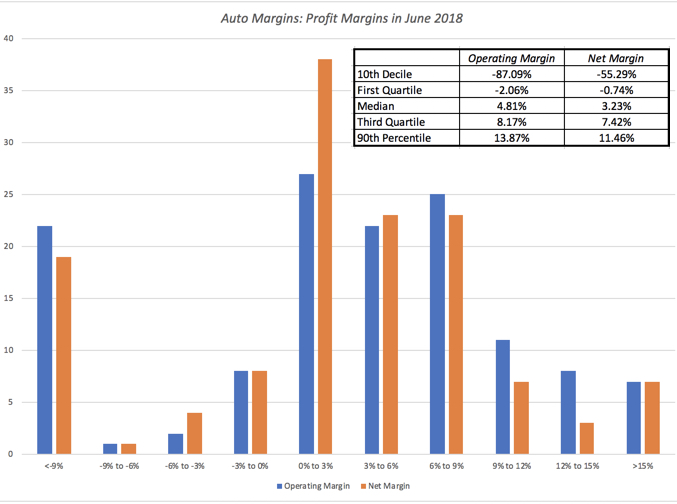
  2. Operating Margin: No matter how you slice it, Tesla is losing money, and it happens to operate in a sector where profit margins have been under pressure for a while, driven partly by competition and partly by changes in the business itself. In the chart below, I have a distribution of operating margins for global auto companies in June 2018:
    Global Auto Data
    Note that the median pre-tax operating  margin for auto companies is only 4.81%, with double digit operating margins putting you at the 80th percentile of all auto companies. It is also worth noting that among the ten largest auto companies, there is not a single one that generates an operating margin higher than 10%; BMW has the highest margin, at 9.89%.
  3. Reinvestment: Scaling up revenues will require significant reinvestment, especially in the auto business. One simple measure of this reinvestment is the sales to invested capital ratio, measuring how much revenue a dollar in invested capital generates. Looking at this measure across the global auto business, here is what I see:
    Note that the global auto business is capital intensive, with a dollar in capital invested generating only $1.29 in revenue at the median firm, and that Tesla, over its history, has been even more capital intensive, generating less revenue per dollar invested than the typical auto firm, with capital intensity increasing after the Solar City acquisition. Tesla's counter to this has  been that by bringing in technology into assembly lines, they will become more efficient than other auto companies, but that argument has lost some of its luster after the last few months, with Musk openly admitting that the robots that Tesla had hoped to put on the factory floor were not doing their jobs. 
  4. Risk: There are two dimensions through which risk affects Tesla's value. The first is the cost of capital, which reflects the operating risk at the company. As an auto company, Tesla is exposed to economic cycles and its cost of capital will reflect that risk:
    Global Auto Data
    The second is the risk of failure and distress, and while being a small, money-losing company is one reason for exposure, Tesla has magnified its risk by borrowing billions of dollars. 
Possible, Plausible and Probable Tesla Stories
I have long argued that every valuation tells a story and that one way to check your valuation is to check to pass your story through the 3P test: Is it possible? Is it plausible? Is it probable? If this sounds like a play on words, note that each test sets a higher standard than the previous one. There are lots of possible stories, a subset of plausible stories and an even smaller set of probable stories. 

Tesla is a stock where there are widely divergent stories, with bullish investors telling big stories with happy endings, that deliver large values for the company, and bearish investors pushing much smaller stories, some with bad endings. In this section, I will start by offering some solace for Tesla bulls by looking at a plausible story that delivers a value greater than the current stock price, then argue that Elon Musk's story for the company, or at least the version that he is telling right now,  is an impossible story and close with my (still upbeat) story for the stock and resulting value.

Getting to $400/share: A Plausible Story?
Is it plausible that Tesla, notwithstanding all of the troubles weighing it down, is under valued, at its current stock price of $340/share? Yes, but only it can put together the following results:
  1. Increase revenues ten-fold over the next decade: Tesla's current revenues of $12.5 billion will have to increase to $120 billion or more in the next ten years, giving it revenues close to those of BMW today. Assuming an average car price of $60,000, that would translate into 2 million cars sold in year 10, illustrating why the focus on whether Tesla can hit its target of 5,000 cars a week is missing the big picture.
  2. Improve operating margins to match the most profitable auto companies: While Tesla scales up its revenues, it will not only have to become profitable (a minimal requirement) but much more so than the typical auto company. In fact, its pre-tax operating margin will climb to 12%, well above the median auto margin of 4.81% or BMW's 9.89%, powered by brand name and pricing power.
  3. Invest more efficiently than the sector: To accomplish its objectives of increasing revenues and ramping up profitability, Tesla will have to reinvest and reinvest efficiently, delivering about $2.25 in revenues for every dollar of capital invested, much higher than than the typical auto firm. To provide perspective, Tesla in year 10 will have to deliver BMW-like revenues ($120 billion) with about a third of BMW's invested capital; with the estimated sales to capital ratio, Tesla's invested capital in year 10 will be $64 billion, whereas BMW's invested capital in 2018 was $185 billion).
  4. Navigate its way through debt to safety: Finally, as it moves towards becoming a much larger, more profitable firm, Tesla will also have to meet its commitments on current debt and not add to the mix, at least for the near term. In terms of operating risk, Tesla will have to face a cost of capital of 8.29%, in line with the typical auto firm.
Download spreadsheet
With these assumptions in place, the value that I get per share is $412, but as you can see from the assumptions, it would be the equivalent of a Royal Flush in poker. Note also that in this optimistic story, Tesla will have to have to raise $14 billion in fresh capital over the next few years and will not become operating cash flow positive until 2025. I am sure that there are people who will be unfazed by this story, especially if they are true believers in Elon Musk, but I am not one of them.

The Musk Story for Tesla: A Fairy Tale?
With a story stock, it is imperative that you have a CEO who not only is able to get the market to buy into a big story, but one who stays focused and disciplined. To me, there is no better example of how to do this well than Amazon, where Jeff Bezos has been consistent in telling the same story for the company, since its inception in 1997, and delivering on that story. Elon Musk is a gifted story teller, but as the last few months have shown, focus and discipline are not his strong points.

If you are a Tesla investor, your primary concern should be that Musk, with his numerous and often conflicting claims about the company, has muddled the Tesla story and perhaps put the company at risk. If Musk is to be believed, and the company will turn the corner on profitability soon and will not need to go back to capital markets in the near future, while also scaling up production and revenues. While that would be wonderful, from a value perspective, it is fantasy. Put bluntly, there is no chance that Tesla can deliver what it needs to, in terms of scaling up revenues and improving profitability, to justify its market capitalization, without raising new equity along the way. Either Musk knows this, and really does not mean what he says, in which case he is being deceptive, or he does not, in which case he is delusional. Neither is a good character quality in a CEO, especially one at a young company that needs investors on its side.

The fact that Tesla's stock price has remained at elevated levels, and even risen, may lead some to conclude that Musk's behavior has no consequences, but I believe it not only will, but it already has  hurt the company. For instance, I think that Tesla has got a bum's rap for some of the accidents that its cars have been in, either from malfunctioning auto-pilots or combustible cars. However, Tesla's hand is weakened by Elon Musk not only acting as the spokesperson for the company but by his responses, which are a mix of arrogance and victimhood (blaming the media, short sellers and analysts) that sap whatever sympathy bystanders may have for the company.

My Tesla Story in June 2018
My story for Tesla is still an optimistic one, but it is much less so than the Royal Flush story that delivered a value in excess of $400. I do think that Tesla will be able to grow revenues substantially over the next decade and improve margins to rank among the more profitable auto companies. I also think that Elon Musk will back track on his promise of not having to raise fresh capital and that Tesla will invest billions into new plant and equipment, and do so more efficiently than other auto companies, partly because it is not saddled with legacy investments. On the risk front, I am comfortable with assuming that operating risk will stabilize over time, but I do think that the debt burden will pose a danger to survival, at least for the next year or two. Pulling these assumptions together, I revalued the firm at about $186/share.
Download spreadsheet
In this story, Tesla's capital needs will be even higher than under the Royal Flush story, with negative cash flows for the next eight years, and $22 billion in new capital over that period. That may strike some as pessimistic, but notwithstanding all the talk about robots and technology, this remains a capital intensive business. It is entirely possible that over the next few weeks, Tesla might be able to get its production up to 5000 cars a week, using tents and spare parts, but that is not a long term solution. There is no tent big enough to produce 30,000 cars a week, which would be Tesla's target in my story, in year 10. 

Bottom Line
There is no denying the fact that Elon Musk has been central to the Tesla story and that his vision and charisma have been largely responsible for pushing the stock price to its current levels. That said, we are at a point in Tesla's history where I think that the question can be raised as to whether the negatives that Musk brings to the job are starting to catch up with, and perhaps overwhelm the positives. Picking fights with equity research analysts and short sellers may get the blood flowing for Tesla bulls, but they are distractions from what Tesla has to do right now. Promising the market that the company will turn the corner on profitability and be cash flow positive soon may signal Musk's faith in his own story, but they do more harm than good for the company's long term value. I know that it is inconceivable for many investors to think of Tesla without Elon Musk at its helm, but this is a company in clear need of checks and balances, either from a strong management team or a powerful board of directors. Unfortunately, neither exists at the company now, and if you are bullish on Tesla, that should scare you.

YouTube Video


Spreadsheets
  1. Auto companies data
  2. Tesla - Royal Flush Valuation (June 2018)
  3. Tesla - My Valuation (June 2018)
Past posts on Tesla
  1. Keystone Kop Valuations: Lazard, Evercore and the TSLA/SCTY deal
  2. Tesla: It's a story stock, but what's the story?
  3. A Tesla  2017 Update: A Disruptive Force and a Debt Puzzle
Share:

Friday, August 11, 2017

A Tesla 2017 Update: A Disruptive Force and a Debt Puzzle!

These are certainly exciting times for Tesla. The first production version of the Tesla 3 was unveiled on July 28, with few surprises on the details, but plenty of good reviews. Elon Musk was his usual self, alternating between celebrating success and warning investors in the stock that the company was approaching "manufacturing hell", as it ramps up its production schedule to meet its target of producing 10,000 cars a week. It is perhaps to cover the cash burn in manufacturing hell that Tesla also announced that it planned to raise $1.5 billion in a junk bond offering. Investors continued to be unfazed by the negative and lapped up the positive, as the stock price soared to $365 at close of trading on August 9, 2017. With all of this happening, it is time for me to revisit my Tesla valuation, last updated in July 2016, and incorporate, as best as I can, what I have learned about the company since then.

Tesla: The Story Stock
I have been following Tesla for a few years and rather than revisit the entire history, let me go back to just my most recent post on the company in July 2016, where I called Tesla the ultimate story stock. I argued that wide differences between investors on what Tesla is worth can be traced to divergent story lines on the stock. I used the picture below to illustrate the story choices when it comes to Tesla, and how those choices affected the inputs into the valuation.


In that post, I also traced out the effect of story choices on value, by estimating how the numbers vary, depending upon the business, focus and competitive edge that you saw Tesla having in the future:

With my base case story of Tesla being an auto/tech company with revenues pushing towards mass market levels and margins resembling those of tech companies, I estimated a value of about $151 a share for the company and my best case estimate of value was $316.46.

Tesla: Operating Update
If you are invested in or have been following Tesla for the last year, you are certainly aware that the market has blown through my best case scenario, with the stock trading on August 9, at $365 a share, completing a triumphant year in markets:

As Tesla's stock price rose, it broke through milestones that guaranteed it publicity along the way. It's market capitalization exceeded that of Ford and General Motors in April 2016, and in June 2016, Tesla leapfrogged BMW to become the fourth largest market cap automaker in the world, though it has dropped back a little since. It now ranks fifth, in market capitalization, among global automobile companies:
Largest Auto Companies (Market Capitalization) on August 9, 2017
While Tesla's market cap has caught up with larger and more established auto makers, its production and revenues are a fraction of theirs, leading some to use metrics like enterprise value per car sold to conclude that Tesla is massively over valued. I don't have much faith in these pricing metrics to begin with, but even less so when comparing a company with massive potential to companies that are in decline, as I think many of the conventional auto companies in this table are currently.

As I noted at the start of the post, it has been an eventful year for Tesla, with the completion of the Solar City acquisition, and the Tesla 3 dominating news, and its financial results reflect its changes as a company. In the twelve months ended June 30, 2017, Tesla's revenues hit $10.07 billion, up from $7 billion in its most recent fiscal year, which ended on December 31, 3016; on an annualized basis, that translates into a revenue growth rate of 107%. That positive news, though, has to be offset at least partially with the bad news, which is that the company continues to lose money, reporting an operating loss of $638 million in the most recent 12 months, with R&D expensed, and a loss of $103 million, with capitalized R&D. The growth in the company can be seen by looking at how quickly its operations have scaled up, over the last few years:

Tesla's growth has not just been in the operating numbers but in its influence on the automobile sector. While it was initially dismissed by the other automobile companies as a newcomer that would learn the facts of life in the sector, as it aged, the reverse has occurred. It is the conventional automobile companies that are, slowly but surely, coming to the recognition that Tesla has changed their long-standing business. Volvo, a Swedish automaker not known for its flair, announced recently that all of its cars would be either electric or hybrid by 2019, and Ford's CEO was displaced for not being more future oriented. A little more than a decade after it burst on to the scene, it is a testimonial to Elon Musk that he has started the disruption of one of the most tradition-bound sectors in business.

Tesla: Valuation Update
The production hiccups notwithstanding, the company continues to move towards production of the Tesla 3, with the delivery of the handful to start the process. There is much that needs to be done, but I consider it a good sign that the company sees a manufacturing crunch approaching, since I would be concerned if they were to claim that they could ramp up production from 94,000 to 500,000 cars effortlessly.  My updated story for Tesla is close to the story that I was telling in July 2016, with two minor changes. The first is that the production models of the Tesla 3 confirm that the company is capable of delivering a car that can appeal to a much broader market than prior models, putting it on a  pathway to higher revenues. My expected revenues for Tesla in ten years are close to $93 billion, a nine-fold increase from last year's revenues and a higher target than the $81 billion that I projected in my July 2016 valuation. Second, the operating margins, while still negative, have become less so in the most recent period, reducing reinvestment needs for funding growth. The free cash flows are still negative for the next seven years, a cash burn that will require about $15.5 billion in new capital infusions over that period. With those changes, the value per share that I estimate is about $192/share, about 20% higher than my $151 estimate a year ago, but well below the current price per share of $365.
Download spreadsheet
As with every Tesla valuation that I have done, I am sure (and I hope) that you will disagree with me, with some finding me way too pessimistic about Tesla's future, and others, much too optimistic. As always, rather than tell me what you think I am getting wrong, I would encourage you to download the spreadsheet and replace my assumption with yours. I think I am being clear eyed about the challenges that Tesla will face along the way and here are the top three: 
  1. Can Tesla sell millions of cars? One of Tesla's accomplishments has been exposing the potential of the hybrid/electric car market, even in an era of restrained fuel prices. That is good news for Tesla, but it has also woken up the established automobile companies, as is evidenced by not only the news from Volvo and Ford, but also in increased activity on this front at the other automobile companies. In my valuation, the revenues that I project in 2027 will require Tesla to sell close to 2 million cars, in the face of increased competition.
  2. Can it make millions of cars? Tesla's current production capacity is constrained and there are two production tests that Tesla has to meet. The first is timing, since the Tesla 3 deliveries have been promised for the middle of 2018, and the assembly lines have to be humming by then. The second is cost, since a subtext of the Tesla story, reinforced by hints from Elon Musk, is that the company has found new and innovative ways of scaling up production quickly and at much lower costs than conventional automobile companies. 
  3. Can it generate double digit margins? In my valuation, I assume an operating margin of 12% for Tesla, almost double the average of 6.33% for global auto companies. For Tesla to generate this higher margin, it has to be able to keep production costs low at its existing and new assembly plants and to be able to charge a premium price for its automobiles, perhaps because of its brand name. 
Tesla has shown a capacity to attract and keep customers and I think it is more than capable of meeting the first challenge, i.e., sell millions of cars, especially since its competition is saddled with legacy costs and image problems. It is the production challenge that is the more daunting one, simply because this has always been Tesla's weakest link. Over the last few years, Tesla has consistently had trouble meeting logistical and delivery targets it has set for itself, and those targets will only get more daunting in the years to come. Furthermore, if its production costs run above expectations, it will be unable to deliver on higher margins. To succeed, Tesla will require vision, focus and operating discipline. With Elon Musk at its helm, the company will never lack vision, but as I argued in my July 2016 post, Mr. Musk may need a chief operating officer at his side to take care of delivery deadlines and supply chains. 

Financing Cash Burn: Tesla's Odd Choice
There is much to admire in the Tesla story but there is one aspect of the story that I find puzzling, and if I were an equity investor, troubling. It is the way in which Tesla has chosen to, and continues to, finance itself. Over the last decade, as Tesla has grown, it has needed substantial capital to finance its growth. That is neither surprising nor unexpected, since cash burn is part of the pathway to glory for companies like Tesla. However, Tesla has chosen to fund its growth with large debt issues, as can be seen in the graph below:

That debt load, already high, given Tesla’s operating cash flows is likely to get even bigger if Tesla succeeds in its newest debt issue of $1.5 billion, which it is hoping to place with an interest rate of 5.25%, trying to woo bond buyers with the same pitch of growth and hope that has been so attractive to equity markets. That suggests that those making the pitch either do not understand how bonds work (that bondholders don't get to share much in upside but share fully in the downside) or are convinced that there are enough naive bond buyers out there, who think that interest payments can be made with potential and promise.

But setting aside concerns about bondholders, the debt issuance makes even less sense from Tesla's perspective. Unlike some, I don’t have a kneejerk opposition to the use of debt. In fact, given that the tax code is tilted to benefit debt, it does make sense for many companies to use debt instead of equity. The trade off, though, is a simple one:

If you look at the trade off, you can see quickly that Tesla is singularly unsuited to using debt. It is a company that is not only still losing money but has carried forward losses of close to $4.3 billion, effectively nullifying any tax benefits from debt for the near future (by my estimates, at least seven years). With Elon Musk, the largest stockholder at the company, at the helm, there is no basis for the argument that debt will make managers more disciplined in their investment decisions. While the benefits from debt are low to non-existent, the costs are immense. The company is still young and losing money, and adding a contractual commitment to make interest payments on top of all of the other capital needs that the company has, strikes me as imprudent, with the possibility that one bad year could put its promise at risk. Finally, in a company like Tesla, making large and risky bets in new businesses, the chasm between lenders and equity investors is wide, and lenders will either impose restrictions on the company or price in their fears (as higher interest rates). So, why is Tesla borrowing money? I can think of two reasons and neither reflects well on the finance group at Tesla or the bankers who are providing it with advice.
  1. The Dilution Bogeyman: The first is that the company or its investment bankers are so terrified of dilution, that a stock issue is not even on the table. Once the dilution bogeyman enters the decision process, any increase in share count for a company is viewed as bad, and you will do everything in your power to prevent that from happening, even if it means driving the company into bankruptcy. 
  2. Inertia: Auto companies have generally borrowed money to fund assembly plants and the bankers may be reading the capital raising recipe from that same cookbook for Tesla. That is incongruent with Elon Musk’s own story of Tesla as a company that is more technology than automobile and one that plans to change the way the auto business is run.
Tesla’s strengths are vision and potential and while equity investors will accept these as down payments for cash flows in the future, lenders will not and should not. In fact, I cannot think of a better case of a company that is positioned to raise fresh equity to fund growth than Tesla, a company that equity investors love and have shown that love by pushing stock prices to record highs. Issuing shares to fund investment needs will increase the share count at Tesla by about 3-4% (which is what you would expect to see with a $1.5 billion equity issue) but that is a far better choice than borrowing the money and binding yourself to make interest payments.  There will be a time and a place for Tesla to borrow money, later in its life cycle, but that time and place is not now. If Tesla is dead set on not raising its share count, there is perhaps one way in which Tesla may be able to eat its cake and have it too, and that is to exploit the dilution bogeyman's blind spot, which is a willingness to overlook potential dilution (from the issuance of convertibles and options). In fact, why not issue long term, really low coupon convertible bonds, very similar to this one from 2014, a bond only in name since almost all of its value came from the conversion option (which is equity with delayed dilution)?

Conclusion

The Tesla story continues to evolve, and there is much in the story that I like. It is changing the automobile business, a feat in itself, and it is starting to deliver on its production promises. The next year may be manufacturing hell, but if the company can make its through that hell and find ways to deliver the tens of thousands of Tesla 3s that it has committed to delivering, it will be well on its way. I still find the stock to be too richly priced, even given its promise and potential, for my liking, but I understand that many of you may disagree. That said, though, I do think that the company's decision to use debt to fund its operations makes no sense, given where it is in the life cycle.

YouTube Video


Previous Blog Posts
  1. Tesla: It's a story stock, but what's the story? (July 2016)

Spreadsheet Attachments
  1. Tesla Valuation: August 2017
  2. Tesla Valuation: July 2016
Share:

Labels

Blog Archive

Recent Posts

Unordered List

Theme Support