• This is default featured slide 1 title

    Go to Blogger edit html and find these sentences.Now replace these sentences with your own descriptions.This theme is Bloggerized by Lasantha Bandara - Premiumbloggertemplates.com.

  • This is default featured slide 2 title

    Go to Blogger edit html and find these sentences.Now replace these sentences with your own descriptions.This theme is Bloggerized by Lasantha Bandara - Premiumbloggertemplates.com.

  • This is default featured slide 3 title

    Go to Blogger edit html and find these sentences.Now replace these sentences with your own descriptions.This theme is Bloggerized by Lasantha Bandara - Premiumbloggertemplates.com.

  • This is default featured slide 4 title

    Go to Blogger edit html and find these sentences.Now replace these sentences with your own descriptions.This theme is Bloggerized by Lasantha Bandara - Premiumbloggertemplates.com.

  • This is default featured slide 5 title

    Go to Blogger edit html and find these sentences.Now replace these sentences with your own descriptions.This theme is Bloggerized by Lasantha Bandara - Premiumbloggertemplates.com.

Showing posts with label prices and value. Show all posts

Friday, February 22, 2019

January 2019 Data Update 9: The Pricing Game

In my last eight posts, I looked at aspects of corporate behavior from investments to financing to dividend policy, using the data that I collected at the start of 2019, to examine what companies share in common, and what makes them different. In summary, I found that the rise in risk premiums in both equity and bond markets in 2018 have pushed up costs of equity and capital, that companies across the globe are finding it difficult to generate returns on their investments that exceed their costs of funding, and that many of them, especially in mature businesses, are returning more cash, much of it in the form of buybacks. Since all of the companies in my data set are publicly traded, there is one final number that I have not addressed directly in my posts so far, and that is the market pricing of these companies. In this post, I  complete my data update series, by looking at how pricing varies across companies, sectors and geographies, and what lessons investors can draw from the data.

Value versus Price: The Difference
I have posted many times on the between the value of an asset and its' pricing, but I don't think it hurts to revisit that difference. The determinants of value are simple, although not always easy to estimate. Whether you are valuing start-up businesses, emerging market firms, or commodity companies, the values are driven by expected cash flows, growth, and risk. Although a discounted cash flow valuation is often the tool that we used to give form to these fundamentals, in the form of cash flows, growth rates in these cash flows, and discount rates, it is not the only pathway to intrinsic value.  The determinants of price are demand and supply, and while fundamentals do affect both, mood and momentum are also strong forces in pricing. These “animal spirits,” as behavioral economists might tag them, can not only cause price to diverge from value, but also require different tools to be used to assess the right pricing for an asset. With many assets and businesses, pricing an asset usually involves standardizing a price (a multiple), finding similar or comparable assets that are already priced in the marketplace, and controlling for differences. The picture below, which I have used many times before, captures the two processes:

The reason that I reuse this picture so much is because, to me, it is an all-encompassing snapshot of every conceivable investment philosophy that exists in the market:
  1. Efficient Marketers: If you believe that markets are efficient, the two processes will generate the same number, and any gap that exists will be purely random and quickly closed.
  2. Investors: If you are an investor, whether value or growth, and you truly mean it, your view is that the pricing process, for one reason or the other, can deliver a price different from your estimate of value and that the gap that exists will close, as the price converges to value. The difference between value and growth investors lies in where you think markets are most likely to make mistakes (in valuing existing assets or growth opportunities) and correct them. In essence, you are as much a believer in efficient markets as the first group, with the only difference being that you believe markets become efficient after you have taken your position on a stock. 
  3. Traders: If you are a trader, you start off with either the presumption that there is no such thing as intrinsic value, or that it exists, but that no one can estimate it. You play the pricing game, effectively using your skills at gauging momentum and forecasting the effects of corporate news on prices, to buy at a low price and sell at a high price.
Market participants are most exposed to danger when they are delusional about the game that they are playing. Many portfolio managers, for instance, claim to be investors, playing the value game, while using pricing screens (PE and growth, PBV and ROE) and adding to their holdings of momentum stocks. Many traders seem to think that they will be viewed as deeper and more accomplished if they talk the value talk, while using charts and technical indicators in the closet, to make their stock picks.

The Pricing Process
The essence of pricing is attaching a number to an asset or company, based upon how similar assets and companies are being priced in the market. To get insight into how to price an asset, a business or a company, you should break down the pricing process into steps:

You may be a little puzzled by the first step in the process, where I standardize the price, but the reason is simple. You cannot compare price per share across companies, since it is a function of the share count, which can be changed overnight in a stock split. To standardize prices, you scale them to some variable that all of the assets in the peer group share. With real estate properties, you divide the price of each property by its square footage to arrive at a price/square foot that can be compared across properties. With businesses, you scale pricing to an operating variable, with earnings being the most obvious choice, but it can be revenues, cash flows or book value. Note that any multiple that you find on a stock or company is embedded in this definition, ranging from PE ratios to EV/EBITDA multiples to revenue multiples, and even beyond, to market price per subscriber or user. The second step in the process, i.e., finding similar assets and companies, should make clear the fact that this is a process that requires subjective judgments and is open to bias, just as is the case in intrinsic valuation. If you are pricing Nvidia, for instance, you determine how narrowly or broadly you define the peer group, and which companies to deem to be "similar".  The third step int he process requires controlling for differences across companies. Put simply, if the company that you are pricing has higher growth or lower risk or better returns on its investments on it projects that the companies in the peer group, you have to adjust the pricing to reflect it, either subjectively, as many analysts do, with story telling, or objectively, by bringing in key variables into the estimation process.

Pricing the Markets in January 2019
Rather than taking you through multiple after multiple, and overwhelming with pictures and tables on each one, I will list out what I learned by looking at the pricing of all publicly traded stocks around the world, in early 2019, in a series of pricing propositions.

Pricing Proposition 1: Absolute rules don't belong in a relative world!
Paraphrasing Einstein, everything is relative, if you are pricing companies. Is a PE ratio of five low? Not if half the stocks in the market trade at less than five. Is an EV/EBITDA of forty high? Perhaps in some sectors, but not if you are comparing high growth companies in a highly priced sector. Old time value investing is filled with rules of thumb, and many of these rules are devised around absolute values for PE or PEG ratios or Price to Book, at odds with the very notion of pricing. If you want to make pricing statements about what comprises cheap or expensive, you should be looking at the distribution of the multiple across the market. Thus, to form pricing rules on US stocks at the start of 2019, I looked the distribution of current, forward and trailing PE ratios for US stocks on January 1, 2019:

At the start of 2019, a low trailing PE ratio for a US stock would have been 6.09, if you used the lowest decile or 10.36, if you moved to the first quartile, and a high PE ratio, using the same approach, would have been 27.31, with the third quartile, or 53.70, with the top decile. Lest I be accused of picking on value investors, they are not the only or even the biggest culprits, when it comes to absolute rules. Private equity investors and LBO initiators have built their own set of screens. I have lost count of the number of times I have heard it said that an EV to EBITDA less than six (or five or seven) must mean that a company is not just cheap, but a good candidate for leverage, but is that true? To answer the question, I looked at the EV to EBITDA multiples across companies, across regions of the world.
If you wield a pricing bludgeon and declare all companies that trade at less than six times EBITDA to be cheap, you will find about half of all stocks in Russia to be bargains. Even globally, you should hav no trouble finding investments to make with this rule, since almost one quarter of all companies trade at less than six times EBITDA.  My point is not that that you cannot have rules of thumb, since they do exist for a reason, but that those rules, in a pricing world, have to be scaled to the data. Thus, if you want to define the first decile as your measure of what comprises cheap, why not make it the first decile? That would mean that an EV to EBITDA multiple less than 5.16 would be cheap in the US on January 1, 2019, but that number would have to recalibrated as the market moves up or down.

Pricing Proposition 2: Markets have a great deal in common, when it comes to pricing, but the differences can be revealing!
Much is made about the differences across global equity markets, and especially about the divide between emerging and developed market companies, when it comes to pricing, with delusions running deep on both sides. Emerging market analysts are convinced that stocks are priced very differently, and often more irrationally, in their local markets, leaving them free to devise their own rules for their markets. Conversely, developed market analysts often bring perspectives about what comprises high, low or average pricing ratios, built up through decades of exposure to US and European markets, to emerging markets and find them puzzling. The data tells a different story, with pricing ratios around the world having distributional characteristics that are surprisingly similar across different parts of the world:

While the levels of PE ratios vary across regions, with Chinese stocks having the highest median PE ratios (20.63) and Russian and East European stocks the lowest (9.40), they all have the same asymmetric look, with a peak to the left (since PE ratios cannot be lower than zero) and a tail to the right (there is no cap on PE ratios). That asymmetry, which is shared by all pricing multiples, is the reason that you should always be cautious about any pricing argument that is built on comparisons to the average PE or PBV, since those numbers will be skewed upwards because of the asymmetry.  While it is true that markets share common characteristics, when it comes to pricing, the differences in levels are also worth paying attention to, when investing. A global fund manager who ignores these differences, and picks stocks based upon PE ratios alone, will end up with a portfolio that is dominated by African, Midde East and Russian stocks, not a recipe for investing success.

Pricing Proposition 3: Book value is the most overrated metric in investing
I have never understood the reverence that some investors seem to hold for book value, as revealed in the number of investing adages built around it. Stocks that trade at less than book value are considered cheap, and companies that build up book value are considered to be value creating. At the root of the "book value" focus are two assumptions, sometimes stated but often implicit. The first is that the book value is a measure of liquidation value, an estimate of what investors would get if they shut down the company today and sold its assets. The second is that accountants are consistent and conservative in estimating asset value, unlike markets, which are prone to mood swings. Both assumptions are built on foundations of sand, since book value is not a good measure of liquidation value in most sectors, and accountants are both inconsistent and slow-moving, when it comes to estimating and adjusting book value. Again, to get perspective, let's look at the price to book ratios around the world, at the start of 2019:
If you believe that stocks that trade at less than book value are cheap, you will again find lots of bargains in the Middle East, Africa and Russia, but even in markets like the United States, where less than a quarter of all companies trade at less than book value, they tend to be clustered in industries that are in capital intensive (at least as defined by accountants) and declining businesses.
PBV by Industry (US)
Note that among the US industries with the fewest stocks that trade at less than book value are a large number of technology and consumer product companies, with utilities and basic chemicals being the only surprises. On the list of US industry groups with the highest percentage of stocks that trade at less than book value are oil companies (at different stages of the business), old time manufacturing companies and life insurance. If you pick your stocks based upon low price to book, in January 2019, your portfolio will be weighted with companies in the latter group, a prospect that should concern you.

Pricing Proposition 4: Most stocks that look cheap deserve to be cheap!
There are traders who have little time for fundamentals, arguing that they have little or no role to play in day to day movements of stock prices. That is probably true, but fundamentals do have significant explanatory power, when it comes to why some companies trade at low multiples of earnings or book value and others are high multiples. To understand the link, I find it most useful to go back to a simple intrinsic value model, and with simple algebraic manipulation, make it a model for a pricing multiple. The picture below shows the paths you would take with an equity multiple (Price to Book) and an enterprise value (EV/Sales) to arrive at their determinants:
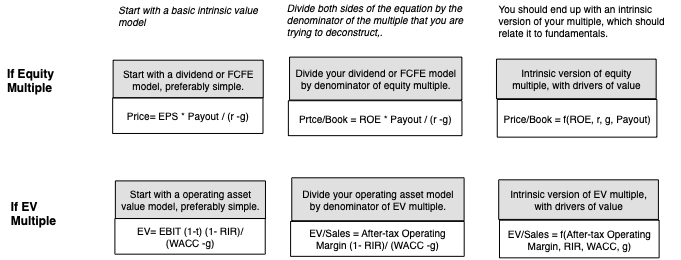
Now what? If you buy into the intrinsic view of a price to book ratio, it should be higher for firms that earn high returns on equity, have higher growth and lower risk, and lower for firms that earn low returns on equity, have lower growth and higher risk. Does the market price in fundamentals? For the most part, the answer is yes, as you can see even in the tables that I have provided in this post so far. Russian stocks have the lowest PE ratios, but that reflects the corporate governance concerns and country risk that investors have when investing in them. Chinese stocks in contrast have the highest PE ratios, because even with stepped down growth prospects for the country, they have higher expected growth than most developed market companies. Looking at stocks with the lowest price to book ratios, Middle Eastern stocks have a disproportionate representation because they earn low returns on equity and the industry groupings with the lowest price to book (oil industry groups, steel etc.) also share that feature. Pricing, done right, is therefore a search for mismatches, i.e., companies that look cheap on a pricing multiple without an obvious fundamental that explains it. This table captures some of the mismatches:

MultipleKey DriverValuation Mismatch
PE ratioExpected growthLow PE stock with high expected growth rate in earnings per share
PBV ratioROELow PBV stock with high ROE
EV/EBITDAReinvestment rateLow EV/EBITDA stock with low reinvestment needs
EV/capitalReturn on capitalLow EV/capital stock with high return on capital
EV/salesAfter-tax operating marginLow EV/sales ratio with a high after-tax operating margin

Pricing Proposition 5: In pricing, it is not about what "should be" priced in, but "what is" priced in!
In the last proposition, I argued that markets for the most part are sensible, pricing in fundamentals when pricing stocks, but there will be exceptions, and sometimes large ones, where entire sectors are priced on variables that have little to do with fundamentals, at least on the surface. This is especially true if the companies in a sector are early in their life cycles and have little to show in revenues, very little (or even negative) book value and are losing money on every earnings measure. Desperation drives investors to look for other variables to explain prices, resulting in companies being priced based upon website visitors (at the peak of the dot com boom), numbers of users (at the start of the social media craze) and numbers of subscribers.

I noted this phenomenon, when I priced Twitter ahead of its IPO in 2013, and argued that to price Twitter, you should look at its user base (about 240 million at the time) and what markets were paying per user at the time (about $130) to arrive at a pricing of $24 billion, well above my estimate of intrinsic value of $11 billion for the company at a time, but much closer to the actual pricing, right after the IPO.  It is therefore neither surprising nor newsworthy that venture capitalists and equity research analysts are more focused on these pricing metrics, when assessing how much to pay for stocks, and companies, knowing this, play along, by emphasizing them in their earnings reports and news releases.

Conclusion
I do believe in intrinsic value, and think of myself more as an investor than a trader, but I am not a valuation snob. I chose the path I did because it works for me and reflects my beliefs, but it would be both arrogant and wrong for me to argue that being a trader and playing the pricing game is somehow less worthy of respect or returns. In fact, the end game for both investors and traders is to make money, and if you can make money by screening stocks using PE ratios or technical indicators, and timing your entry/exit by looking at charts, all the more power to you! If there is a point to this post, it is that a great deal of pricing, as practiced today, is sloppy and ignores, or throws away, data that can be used to make pricing better.
Data Links
  1. PE ratios by industry grouping: USEuropeEmerging MarketsJapanAustralia & CanadaIndia and China
  2. Book Value Multiples by industry grouping: USEuropeEmerging MarketsJapanAustralia & CanadaIndia and China
  3. EV to EBIT & EBITDA by industry grouping: USEuropeEmerging MarketsJapanAustralia & CanadaIndia and China
  4. EV to Sales by industry grouping: USEuropeEmerging MarketsJapanAustralia & CanadaIndia and China
  5. Pricing Multiples, by country
Share:

Monday, September 10, 2018

Trillion Dollar Toppers: Market Triggers, Value Drivers and Pricing Catalysts!

In the last few weeks, the market capitalization of Apple and Amazon each hit a trillion dollars, a threshold not seen before in public markets. Predictably, that has drawn press attention and commentary about what this moment means for markets, investors and the companies themselves. As readers of this blog know, I have followed both companies and valued them for more than two decades, and this is as good a time as any to see how they got to where they are today, and what the future holds for each company. I will do that in my next post, but in this one, I want to look at the far more basic question of whether hitting a trillion dollar value (or a hundred billion or a billion or any other number) should matter to investors.

Market Triggers
Does the market capitalization rising above a trillion dollars change Amazon or Apple as companies? After all, $1,000,000,000,000 is only a dollar higher than $999,999,999,999 and nothing is changed fundamentally in either company by the event. That said, as human beings, we do make more of a fuss around some numbers than others, especially with age and birthdays. In some cases, the fuss is merited, as when you turn eighteen, since you will be able to vote and be treated as an adult in the legal system, or sixty five, since you may be entitled to your pension and social security benefits. In others, it is a concocted milestone, as is the case when you turn thirty or forty or fifty years old, since little changes in your life, as a consequence.

Investors also seem to endow some numbers with more weight than others, sometimes with reason, and sometimes without. When a publicly traded company’s stock price drops below a dollar, it is often punished, often because it risks being delisted, putting liquidity at risk. When the stock prices rises above $1,000, the company may come under pressure to do a stock split, because it has become “too expensive” for retail investors to buy. With young, privately owned companies, getting a pricing of more than a billion dollars gets you unicorn status, though it not clear what that branding entitles you to, other than a little public attention. Within corporate finance, there are similar triggers built around revenues and profits, with management contracts tied to revenues reaching a billion dollars or EBITDA cresting one hundred million. Collectively, I will call these market triggers, and the focus of this post is to examine how much attention we should pay to them, if any.

The Market Reaction to Triggers
Before we embark on the discussion on whether, and if yes, how much attention to pay to market triggers, note that the degree to which these triggers matter varies widely across investors. While some investors view them as side games, there are others who build much of their investing around market triggers. Value investors, and especially those raised on the classics, scoff at price triggers as distractions from their focus on earnings and moats but they often have their own triggers, based upon earnings or book value. In contrast, a great deal of technical analysis, as an investment philosophy, is built on triggers, many built around price per share. Support and resistance lines, the cresting of which have long been viewed as an indicator of future price movements, are based upon prices that may reflect the company’s past history but often have no intrinsic basis. Similarly, chartists often pay heed to historical high and low prices for the stock, arguing that cresting either number could have consequences for future returns. Many technical indicators are built around price or volume metrics with rules of thumb that often have no fundamental justification. 

At this stage, by making this a contest between value investors and chartists, I have probably already forced you to pick a side, and that would be a pity, since I think that both sides have something to learn from the other. For those who believe in efficient markets, it remains an enduring frustration that markets seem to move in response to what looks like, at least on the surface, to be a cosmetic change in the company. In particular, there is research that stock prices seem to react to stock splits, 
  • With stock splits, where the share count changes in proportion to existing holdings, and nothing fundamentally changes about the company, the market not only reacts positively to the split but these stocks continue to do better than expected in the months after.
  • When a stock approaches its 52-week high, there is some evidence that the high price acts as a barrier, making it more likely that the stock will go down than up.
  • There is some evidence that support and resistance lines have price effects; one study focusing on exchange rates concluded that pricing trends in currency rates are more likely to be interrupted at support and resistance lines. 
  • A general study of technical analysis (and price patterns) concludes that technical indicators, such as head-and-shoulders and double bottoms do have a price impact, though it is unclear that you can make money of these price movements.
In short, much as you may be inclined to dismiss technical research as baseless, there is evidence that past price paths can drive future returns.

Some researchers have managed to convince themselves that the market behavior is consistent with an efficient market, with the rationale that these actions operate as signals about future fundamentals, thus explaining the price changes. A stock split, we are therefore told, is a signal to markets that companies feel that they have the cash flows to sustain higher dividends in the future, translating into higher value. I find most signaling stories to be unconvincing, reflecting almost desperate attempts to reconcile a belief in efficient markets with market behavior that is not consistent with that belief. In my experience, market triggers often affect stock prices, sometimes substantially, and it has little to do with signals. Rather than dismiss these triggers as irrational and useless, I need to understand them better, with the intent of separating ones that may be able to incorporate into my investing from those that I am better off ignoring.

Value Drivers and Pricing Catalysts
In the pursuit of understanding why market triggers matter, I find it useful to go back to a contrast between pricing and value that I have talked about before, and draw a distinction between value drivers and price movers.

In short, the value of a business is driven by its fundamentals, but the pricing of a business is determined by demand and supply, and the two processes can yield different numbers, resulting in a gap between price and value. In this framework, market trigger effects can be classified into three groups:
  1. Value effects: If a market trigger has an effect on one or more of the three drivers of value, which are cash flows, growth and business risk, it can affect value. Revenue or earnings triggers set by companies can have an effect on value, if management compensation is tied to them. With some corporate borrowings, there are covenants tied to stock prices or earnings, the violation of which may lead to consequences for the firm, sometimes taking the form of higher interest expenses and sometimes a change in control. With convertible bonds and preferred shares, the conversion price can become a trigger for a change in value, if it results in a significant increase in shares outstanding and in debt ratios. Consider the grant that Tesla’s board of directors gave Elon Musk in March 2018, where he will get billions of dollars in shares and options in the company, if he can deliver on a variety of targets, some related to market capitalization and some to operating performance. Specifically, the board of directors has listed 12 market capitalization tiggers, each of which can result in shares being granted to Mr. Mush, and 16 operating triggers, with eight relating to revenues and  eight to EBITDA. For a Tesla investor, meeting each of these thresholds will be a cause for mixed feelings, joy that revenues, EBITDA and capitalization are increasing, tempered by dilution occurring at the same time. 
  2. Pricing effects: If a market trigger has an effect on market mood or momentum, it can affect prices, even though it has no effect on fundamentals. For instance, the argument that technical analysts use for paying attention to support lines, often based upon historical prices, is that when a company’s stock price drops below its support line, it creates a negative psychological effect that can cause more selling, with prices falling even further. A pricing trigger can also have a liquidity effect, which can affect prices. This has often been the rationale used by some companies, especially those with high priced shares, for stock splits, arguing that retail investors are more likely to trade a $100 stock than a $1000 stock, and that the increased liquidity can translate into higher prices. The liquidity story can also be used the push by many start-ups to get to unicorn status, since doing so may attract more venture capital money, which, in turn, can push up pricing. Finally, there is the herd effect, where crossing a pricing or value trigger can lead people who have been sitting on the sidelines to act, pushing up prices if they decide to buy and pushing down prices when they sell.
  3. Gap (Catalyst) effects: There is a third and more subtle effect from market triggers, which comes from the attention garnered by crossing even an arbitrary threshold. This is especially the case with smaller and lower profile companies, which can often be ignored by investors and analysts, in a market where larger and higher profile companies garner the bulk of coverage. To the extent that these companies are being mispriced, the attention leading from hitting a trigger can lead to a reassessment of the company and perhaps a closing of the gap. Note that this reassessment can cut in both directions, with unnoticed strengths coming to the surface, and increasing the prices of some companies, and unnoticed weaknesses being unearthed in other companies, resulting in prices dropping. 
This framework can be used to judge whether and why market triggers can affect prices. Some do so, because they have value consequences, some because they affect mood and liquidity, some because they are attention gatherers and some because they have all three effects. Most pricing and volume indicators used by technical analysts, for instance, are pure pricing effects, but since the name of the game in pricing is to gauge shifts in mood and momentum, that is understandable. With companies that have management options and convertibles outstanding, crossing some price barriers can create value effects, by diluting share ownership. With companies that have been operating under the radar, a market trigger can lead to more attention being paid to the company, leading to a closing in gaps between value and price.

So, what effect will crossing the trillion-dollar threshold have on Apple and Amazon? Neither company has options or convertibles that will unlock at the trillion dollar capitalization and thus there should be no value effect. There may be a pricing effect, but it is not clear in which direction. On the one hand, you can argue that for some long term holders of the stock, crossing the trillion dollars may be a culmination of a long and successful journey, leading to selling. On the other hand, there are others who may have resisted both stocks as overpriced, who may decide that this is the time to capitulate and buy the stock. As two of the most widely tracked and followed companies in the world already, it is not likely that there will be any major reassessments in either company, on the part of stockholders, nullifying the gap effect. There is one potential black cloud that comes with the increased attention, at least for Amazon, which is that the company's success may be drawing the attention of anti-trust and regulatory authorities, perhaps putting a crimp on its future growth plans globally. I will return to that issue in my next post.

Market Triggers and Investment Philosophies
If market triggers can have value, price and gap effects, how do you incorporate them into investing? The answer depends upon your investment philosophy:
  1. If you are a trader: The essence of trading is that you are playing the pricing game, and to the extent that you are, your success will depend upon how well you can ride the trend and how quickly you spot changes in momentum. Thus, it does not surprise me that charting and technical indicators are built heavily around these triggers. If you are a good trader, and I believe that they are some, your strength is in assessing how these triggers change mood  and getting ahead of the market on these shifts.
  2. If you are a value investor: As someone focused on value, your first instinct may be to ignore market triggers, viewing them as a distraction from your central mission of valuing companies based upon their fundamentals, and then buying undervalued stocks and selling overvalued ones. While I understand that focus, I think that you should consider incorporating pricing triggers into your value mission for two reasons. The first is that a few of these triggers have value effects and ignoring them will mean that you are mis-valuing companies. The second is that to make money as a value investor, you not only have to get value right, but you have to trust the market to correct its mistake, by moving price towards value. Since the latter is often out of your control, I believe that one of the keys to being a good value investor is finding catalysts that can cause the price correction. If market triggers can operate as catalysts, incorporating them into your investment process can unlock the value mistake that you have found. 
I am a value investor, albeit one with perhaps a broader definition of what comprises value than some old time value investors, but I do look at pricing triggers, especially with small cap, lightly followed and emerging market companies. Thus, if I value a stock at $6 a share and it is trading at $4.10/share, but its historical low price is $4 (the support line), I may wait to buy it, hoping for one of two outcomes. The first is that it hits the support line and does not drop below it, signaling a positive shift in momentum, indicating that this would be a good time to buy. The second is that it drops below its support line, resulting in a negative shift in momentum and more selling, allowing me to buy the stock at an even lower price. Thus, while my primary decision of whether to buy or sell a stock is driven by value judgments, the question of when to do it can be affected by market triggers.

My Bottom Line
I own shares in Apple and I don’t own any (right now) in Amazon, and I have explained why in prior posts on both companies.  With my Apple shares, I have been rewarded well over my almost three-year holding period, and the question then becomes whether the trillion dollar market capitalization should make a difference in whether I continue to hold the shares. With Amazon, I saw little reason to buy the stock a few months ago, as I noted in this post, where I argued that it was a great company but not a great investment. The question then becomes whether market capitalization crossing trillion dollars changes that assessment. The final judgment has to wait until the next post, where I will revalue both companies, and look at whether the trillion-dollar trigger has made a difference.

YouTube Video
Share:

Tuesday, October 24, 2017

The Bitcoin Boom: Asset, Currency, Commodity or Collectible?

As I have noted with my earlier posts on crypto currencies, in general, and bitcoin, in particular, I find myself disagreeing with both its most virulent critics and its strongest proponents.  Unlike Jamie Dimon, I don't believe that bitcoin is a fraud and that people who are "stupid enough to buy it" will pay a price for that stupidity. Unlike its biggest cheerleaders, I don't believe that crypto currencies are now or ever will be an asset class or that these currencies can change fundamental truths about risk, investing and management. The reason for the divide, though, is that the two sides seem to disagree fundamentally on what bitcoin is, and at  the risk of raising hackles all the way around, I will argue that bitcoin is not an asset, but a currency, and as such, you cannot value it or invest in it. You can only price it and trade it.

Assets, Commodities, Currencies and Collectibles
Not everything can be valued, but almost everything can be priced. To understand the distinction between value and price, let me start by positing that every investment that I will look at has to fall into one of the following four groupings:
  1. Cash Generating Asset: An asset generates or is expected to generate cash flows in the future. A business that you own is definitely an asset, as is a claim on the cash flows on that business. Those claims can be either contractually set (bonds or debt), residual (equity or stock) or even contingent (options). What assets share in common is that these cash flows can be valued, and assets with high cash flows and less risk should be valued more than assets with lower cash flows and more risk. At the same time, assets can also be priced, relative to each other, by scaling the price that you pay to a common metric. With stocks, this takes the form of comparing pricing multiples (PE ratio, EV/EBITDA, Price to Book or Value/Sales) across similar companies to form pricing judgments of which stocks are cheap and which ones are expensive.
  2. Commodity: A commodity derives its value from its use as raw material to meet a fundamental need, whether it be energy, food or shelter. While that value can be estimated by looking at the demand for and supply of the commodity, there are long lag and lead times in both that make that valuation process much more difficult than for an asset. Consequently, commodities tend to be priced, often relative to their own history, with normalized oil, coal wheat or iron ore prices being computed by averaging prices across long cycles.
  3. Currency: A currency is a medium of exchange that you use to denominate cash flows and is a store of purchasing power, if you choose to not invest. Standing alone, currencies have no cash flows and  cannot be valued, but they can be priced against other currencies. In the long term, currencies that are accepted more widely as a medium of exchange and that hold their purchasing power better over time should see their prices rise, relative to currencies that don't have those characteristics. In the short term, though, other forces including governments trying to manipulate exchange rates can dominate. Using a more conventional currency example, you can see this in a graph of the US $ against seven fiat currencies, where over the long term (1995-2017), you can see the Swiss Franc and the Chinese Yuan increasing in price, relative to the $, and the Mexican Peso, Brazilian Real, Indian Rupee and British Pound, dropping in price, again relative to the $.
  4. Collectible: A collectible has no cash flows and is not a medium of exchange but it can sometimes have aesthetic value (as is the case with a master painting or a sculpture) or an emotional attachment (a baseball card or team jersey). A collectible cannot be valued since it too generates no cash flows but it can be priced, based upon how other people perceive its desirability and the scarcity of the collectible.  
Viewed through this prism, Gold is clearly not a cash flow generating asset, but is it a commodity? Since gold's value has little to do with its utilitarian functions and more to do with its longstanding function as a store of value, especially during crises or when you lose faith in paper currencies, it is more currency than commodity. Real estate is an asset, even if it takes the form of a personal home, because you would have had to pay rental expenses (a cash flow), in its absence. Private equity and hedge funds are forms of investing in assets, currencies, commodities or collectibles, and are not separate asset classes. 

Investing versus Trading
The key is that cash generating assets can be both valued and priced, commodities can be priced much more easily than valued, and currencies and collectibles can only be priced. So what? I have written before about the divide between investing and trading and it is worth revisiting that contrast. To invest in something, you need to assess its value, compare to the price, and then act on that comparison, buying if the price is less than value and selling if it is greater. Trading is a much simpler exercise, where you price something, make a judgment on whether that price will go up or down in the next time period and then make a pricing bet. While you can be successful at either, the skill sets and tool kits that you use are different for investing and trading, and what makes for a good investor is different from the ingredients needed for good trading. The table below captures the difference between trading (the pricing game) and investing (the value game).

The Pricing Game
The Value Game
Underlying philosophy
The price is the only real number that you can act on. No one knows what the value of an asset is and estimating it is of little use.
Every asset has a fair or true value. You can estimate that value, albeit with error, and price has to converge on value (eventually).
To play the game
You try to guess which direction the price will move in the next period(s) and trade ahead of the movement. To win the game, you have to be right more often than wrong about direction and to exit before the winds shift.
You try to estimate the value of an asset, and if it is under(over) value, you buy (sell) the asset. To win the game, you have to be right about value (for the most part) and the market price has to move to that value
Key drivers
Price is determined by demand & supply, which in turn are affected by mood and momentum.
Value is determined by cash flows, growth and risk.
Information effect
Incremental information (news, stories, rumors) that shifts the mood will move the price, even if it has no real consequences for long term value.
Only information that alter cash flows, growth and risk in a material way can affect value.
Tools of the game (1) Technical indicators, (2) Price Charts (3) Investor Psychology (1) Ratio analysis, (2) DCF Valuation (3) Accounting Research
Time horizon
Can be very short term (minutes) to mildly short term (weeks, months).
Long term
Key skill
Be able to gauge market mood/momentum shifts earlier than the rest of the market.
Be able to “value” assets, given uncertainty.
Key personality traits
      (1) Market amnesia (2) Quick Acting (3) Gambling Instincts
      (1) Faith in “value” (2) Faith in markets (3) Patience (4) Immunity from peer pressure
Biggest Danger(s)
Momentum shifts can occur quickly, wiping out months of profits in a few hours.
The price may not converge on value, even if your value is “right”.
Added bonus
Capacity to move prices (with lots of money and lots of followers).
Can provide the catalyst that can move price to value.
Most Delusional Player
A trader who thinks he is trading based on value.
A value investor who thinks he can reason with markets.

As I see it, you can play either the value or pricing game well, but being delusional about the game you are playing, and using the wrong tools or bringing the wrong skill set to that game, is a recipe for disaster.

What is Bitcoin?
The first step towards a serious debate on bitcoin then has to be deciding whether it is an asset, a currency, a commodity or collectible. Bitcoin is not an asset, since it does not generate cash flows standing alone for those who hold it (until you sell it).  It is not a commodity, because it is not raw material that can be used in the production of something useful. The only exception that I can think off is that if it becomes a necessary component of smart contracts, it could take on the role of a commodity; that may be ethereum's saving grace, since it has been marketed less as a currency and more as a smart contracting lubricant.  The choice then becomes whether it is a currency or a collectible, with its supporters tilting towards the former and its detractors the latter. I argued in my last post that Bitcoin is a currency, but it is not a good one yet, insofar as it has only limited acceptance as a medium of exchange and it is too volatile to be a store of value. Looking forward, there are three possible paths that I see for Bitcoin as a currency, from best case to worst case.
  1. The Global Digital Currency: In the best case scenario, Bitcoin gains wide acceptance in transactions across the world, becoming a widely used global digital currency. For this to happen, it has to become more stable (relative to other currencies), central banks and governments around the world have to accept its use (or at least not actively try to impede it) and the aura of mystery around it has to fade. If that happens, it could compete with fiat currencies and given the algorithm set limits on its creation, its high price could be justified.
  2. Gold for Millennials: In this scenario, Bitcoin becomes a haven for those who do not trust central banks, governments and fiat currencies. In short, it takes on the role that gold has, historically, for those who have lost trust in or fear centralized authority. It is interesting that the language of Bitcoin is filled with mining terminology, since it suggests that intentionally or otherwise, the creators of Bitcoin shared this vision. In fact, the hard cap on Bitcoin of 21 million is more compatible with this scenario than the first one. If this scenario unfolds, and Bitcoin shows the same staying power as gold, it will behave like gold does, rising during crises and dropping in more sanguine time periods.  
  3. The 21st Century Tulip Bulb: In this, the worst case scenario, Bitcoin is like a shooting star, attracting more money as it soars, from those who see it as a source of easy profits, but just as quickly flares out as these traders move on to something new and different (which could be a different and better designed digital currency), leaving Bitcoin holders with memories of what might have been. If this happens, Bitcoin could very well become the equivalent of Tulip Bulbs, a speculative asset that saw its prices soar in the sixteen hundreds in Holland, before collapsing in the aftermath.
    I would be lying if I said that I knew which of these scenarios will unfold, but they are all still plausible scenarios. If you are trading in Bitcoin, you may very well not care, since your time horizon may be in minutes and hours, not weeks, months or years. If you have a longer term interest in Bitcoin, though, your focus should be less on the noise of day-to-day price movements and more on advancements on its use as a currency. Note also that you could be a pessimist on Bitcoin and other crypto currencies but be an optimist about the underlying technology, especially block chain, and its potential for disruption.

    Reality Checks
    Combining the section where I classified investments into assets, commodities, currencies and collectibles with the one where I argued that Bitcoin is a "young" currency allows me to draw the following conclusions:
    1. Bitcoin is not an asset class: To those who are carving out a portion of their portfolios for Bitcoin, be clear about why you are doing it. It is not because you want to a diversified portfolio and hold all asset classes, it is because you want to use your trading skills on Bitcoin to supercharge your portfolio returns. Lest you view this as a swipe at cryptocurrencies, I would hasten to add that fiat currencies (like the US dollar, Euro or Yen) are not asset classes either.
    2. You cannot value Bitcoin, you can only price it: This follows from the acceptance that Bitcoin is a currency, not an asset or a commodity. Any one who claims to value Bitcoin either has a very different definition of value than I do or is just making up stuff as he or she goes along.
    3. It will be judged as a currency: In the long term, the price that you attach to Bitcoin will depend on how well it will performs as a currency. If it is accepted widely as a medium of exchange and is stable enough to be a store of value, it should command a high price. If it becomes gold-like, a fringe currency that investors flee to during crises, its price will be lower. Worse, if it is a transient currency that loses all purchasing power, as it is replaced by something new and different, it will crash and burn.
    4. You don't invest in Bitcoin, you trade it: Since you cannot value Bitcoin, you don't have a critical ingredient that you need to be an investor. You can trade Bitcoin and become wealthy doing so, but it is because you are a good trader.
    5. Good trader ingredients: To be a successful trader in Bitcoin, you need to recognize that moves in its price will have little do with fundamentals, everything to do with mood and momentum and big price shifts can happen on incremental information.
    Would I buy Bitcoin at $6,100? No, but not for the reasons that you think. It is not because I believe that it is over valued, since I cannot make that judgment without valuing it and as I noted before, it cannot be valued. It is because I am not and never have been a good trader and, as a consequence, my pricing judgments are suspect. If you have good trading instincts, you should play the pricing game, as long as you recognize that it is a game, where you can win millions or lose millions, based upon your calls on momentum. If you win millions, I wish you the best! If you lose millions, please don't let paranoia lead you to blame the establishment, banks and governments for why you lost. Come easy, go easy!

    YouTube Video


    Past Blog Posts on Crypto Currencies
    Share:

    Monday, June 6, 2016

    Icahn exits, Buffett enters, Whither Apple? Value and Price Effects of Big Name Investing

    In my last post, I looked at Apple, arguing, with a Monte Carlo simulation, that the stock was a good investment at the prevailing market price ($93 at the time of the analysis). I appreciate the many comments that I got on the analysis, some taking issue with the distributions that I used for profit margins and revenue growth and some taking me to task for ignoring the fact that big name investors were either entering and exiting the stock. Those who felt that my valuation was optimistic pointed out that Carl Icahn, a long time and very vocal investor in Apple, had decided to sell his stake in the company on April 28. Some who concurred with my value judgment on Apple pointed out that Berkshire Hathaway (and by extension, Warren Buffett or his proxies) had invested in the company on May 16.  Should Carl Icahn’s decision to sell Apple or Berkshire Hathaway’s choice to buy it change my assessments of value or views on its price? More generally, should the decisions by "big name" investors to buy or sell a specific company affect your investment judgments about that company? 

    Price versus Value: The Set Up
    To set up the discussion of whether, and if so how, the actions of other investors, especially those with big names and reputations to match, affect your investing choices, I will fall back on a device that I have used before, where I contrast the value and pricing processes.


    Put simply, the value process is driven by a company's fundamentals (cash flows, growth and risk) or at least your perception of those fundamentals, whereas  the pricing process is driven by demand and supply, with mood, momentum and liquidity all playing big roles in determining price. In an earlier post,  I argued that it these processes that separate investors from traders, with investors focused on the drivers of value and traders on the pricing process, and that the skills and tools that you need to be a successful trader are different from those that you need to be a successful investor. To understand how and why the entry of a big name investor may alter your assessments of value and price, I would suggest categorizing that investor into one of four types.
    1. An Insider, who is either part of management or has privileged access to management.
    2. An Activist, who plans to change the way the firm is run or financed.
    3. A Trader, whose skill lies in playing the pricing game, with the power to either reinforce or reverse price momentum
    4. A Value Investor, who has valued the company and is willing to take a position based upon that value, on the expectation that the pricing gap will close.
    Each type of big name investor has the potential to change how you view the dynamics of price and value, though the place where the change occurs will depend on the investor type.

    The entry (or exit) of a big name insider or big name activist can alter your estimate of value for a company, by either changing your perceptions of cash flows, growth and risk or by having the potential to change the company's operating and financing characteristics. As a trader, the entry or exit of a big name trader may cause you to move from one side of the pricing game to the other, i.e., shift you from being a buyer to a seller. Finally, as a long term value investor who believes that a stock is mis-priced but has little or no power to cause the pricing gap to close, the entry of a big name value investor can provide a catalyst for the correction.

    The Value Effect 
    If you asked a value purist whether the actions of other investors affect his or her value, the answer will almost always be "of course not". After all, the essence of intrinsic value is that it is determined not by what others think about the company but the company's capacity to generate cash flows  over time. That said, there are two ways that the investment action (to buy or sell) of a big name investor can change your assessment of value. 

    1. The first is if the big name investor has private information or is perceived as knowing more about the firm than you do. While that may walk awfully close to the insider trading line in the United States, it is entirely possible that the investor's information is diffuse enough to not be in violation of the law. In this case, it is entirely rational for you, as an investor, to reassess your cash flows and risk, based upon the insiders' actions. That is perhaps why we are so fascinated by insider trading, where the perception is that insider buying is value increasing and insider selling is value selling. In some emerging markets, where possessing proprietary information is neither illegal nor unusual, and the decision by an investor who is perceived as having this information (an insider, manager or family member) to buy (or sell) is an indicator that your value should be increased (decreased). 
    2. The other scenario is where the big name investor is an activist who plans to push for changes in the way the company operates, how it is financed or how much and how it returns cash to investors. The potential effects of these changes can be most easily seen using a financial balance sheet:

    To the extent that you believe that the company will have to respond to activist pressure, your assessment of value will change. An asset restructuring can alter he cash flows and risk characteristics of a business, changing your estimate of value, though the direction of the value change and its magnitude will depend on how you see these operating changes playing out in cash flows and growth.  Adding debt to your financing mix can add value to a firm (because of the tilt in the tax code towards debt) or destroy value (because it exposes companies to bankruptcy risk). If you are valuing a company, the entry of a big name activist investor in the ranks with a history of pushing for more debt could lead you to reassess your value estimate as well. Returning more cash to stockholders in special dividends or buybacks can change value either upwards (if the market is discounting the cash on the presumption that the company would waste the cash on bad investments/acquisitions) or downwards (if returning the cash will expose the firm to default risk or substantial financing costs in the future).

    The Pricing Effect
    In some cases, the big name investing in the stock is a trader, doing so on the expectation that momentum will either continue, sustaining the pricing trend, or that momentum will reverse, causing the trend to reverse as well. Since this trade is not motivated by either new information or the desire to change how the company is run, there is no value effect, but there can be a price effect for two reasons. 
    1. The volume effect: If the big name trader has enough money to back his or her trade, there will be a liquidity effect, where a buy will push the price up higher and a sell will push it lower. 
    2. The bandwagon effect: To the extent that there are some in the market who perceive the big name trader as better at perceiving momentum swings than the rest of us, they will follow the investor in buying or selling the stock. 
    In contrast to a value effect, which is long term and sustained, the pricing effect will have a shorter half life. To the extent that the big name trader's time horizon may be even shorter, he or she can still make money from the bandwagon effect. To get a measure of the pricing effect of a big name trade, you have to look at both the resources commanded by the trader as well as the liquidity/trading volume in the stock. A trader with billions under his control investing in a lightly traded and lightly followed stock will have a much bigger pricing effect than in a very liquid, large market capitalization company. 

    The Catalyst Effect
    It is an undeniable and frustrating truth about value investing that for most of us, it is not just enough to be right in your assessment of value but you have to get the market to correct its mistakes to make money on your investments. If you are a small investor, there is little that you can do to close the pricing gap because you have neither the money or the megaphone to close the gap. A big name value investor, though, may be more successful for two reasons: he or she can take a larger position in the stock and as with the big name trader, create a bandwagon effect where other value investors will follow into the stock.  Again, the magnitude of the catalyst effect will vary across both investors and companies. The extent of the impact on the pricing gap will depend in large part on the history of success that the big name investor brings into the investment, with sustained success in the past going with a larger impact. 

    Apple, Icahn and Buffett
    It has taken me a while to get to the point of this post, which was ostensibly about Apple and how Icahn’s exit and Buffett’s entry into the stock affect my thinking. At first sight, this graph shows how the market reacted to their actions:

    While it does look like Icahn's sale had a negative effect (albeit mild) and Berkshire's buy had a positive effect (almost as mild), I plan to use the framework of the last section to assess each of these investors and gauge how it should affect my thinking about the stock.

    Icahn, the Activist Trader
    Through much of his tenure, Carl Icahn has been labeled an activist investor but I will take issue with at least a portion of that label. It is true that Icahn is an activist, though he is much more active on the financing/dividend dimension (pushing companies to borrow money and return cash) than on the operating dimension. I do think that Icahn is more of a trader than an activist, more focused on momentum and pricing than on value and this is illustrated by the tools that brings to the assessment. When Icahn was asked why he invested in Lyft in 2015, his response was that it looked cheap relative to Uber, a classic pricing argument. With Apple, in his bullish days, Icahn argued that it was cheap, but consider how he justified his contention in May 2015, that Apple, then trading at $100, should really be trading at $240. In effect, he forecast out earnings per share in 2016 to be $12, applied a PE ratio of 18 and added the cash balance of $24.44/share. Not only is this definitely not an intrinsic valuation, it is at best "casual pricing", i.e., the type of pricing you would do on the back of an envelope after you have had a little too much to drink.

    Before you point out to me that Icahn is worth billions and I am not, let me hasten to add that there is nothing ignoble about trading and that Icahn has been an incredibly successful trader over the last few decades, testimonial to his targeting and trading skills. It does color how I viewed Icahn’s investment in Apple in January 2014, his push at Apple for more dividends and more debt during his days as a Apple investor and his decision to sell his holdings on April 2016. I was already an investor in Apple in January 2014, when Icahn bought his shares, and while I did not view his decision to buy the shares as vindication of my valuation, I welcomed him to the shareholder ranks both because Apple was badly in need of a momentum shift and Icahn was playing both an activist and a catalyst role. I am glad that he put pressure on Apple to get over its unwillingness to borrow money and to return more cash in dividends and buybacks. His decision to depart does tells me two things. First, Icahn has recognized the limitations of financing and dividend policy changes in driving Apple’s value and is moving on to companies where the payoff is greater from financial reengineering. Second, it is possible that Icahn’s momentum detector is telling him that while Apple’s stock price may not be going lower, it has little room to go higher either, at least in the short term, and given his trading track record, I would take that signal seriously,

    Buffett Buys In?
    The decision by Berkshire Hathaway to invest in Apple about three weeks after Icahn’s departure mollified some worried Apple investors, since there is no more desirable endorsement in all of value investment than Warren Buffett’s buy order. I am not privy to the inner workings in Omaha, but I have a feeling that this decision was made more by Todd Combs and Ted Wechsler, the co-heads that Buffett hired as his successors, than by Buffett, but let’s assume that they are following the Buffett playbook. What does that tell you about Apple stock? The good news is that the greatest value investor of this generation now considers Apple to be a value stock. The bad news is that this investor's biggest investment in a technology company has been in IBM, a company that delivers solid dividends and cash flows but has been liquidating itself gradually over the last ten years. If my value judgment on Apple had required substantial growth for value to be delivered, Buffett’s investment could very well have adversely affected my view on the company. In this case, though, I agree with his assessment that Apple is a mature company, with enough cash flows to cover dividends for a generation. 

    The Apple End Game
    In early May, when I analyzed Apple, I knew that Carl Icahn had already closed out his position and it had no impact on my value estimate or investment judgment. Icahn’s decision to sell was an indication to me that the price might not recover quickly and that momentum could work against me in the near term, but I was okay with that, since my time horizon was not constrained. Buffett’s decision (if it was his) to jump in, a couple of weeks later, may be an indication that the best days of Apple are behind it, but I had already made the same judgment in my valuation. If there is a silver lining, it is that Buffett's followers, with their large numbers and unquestioning, will imitate him and perhaps get the price gap to close. 

    The Dark Side of Big Name Investing
    While I am open to the possibility that the entry of a big name into a company has the potential to change the way I think about the company and perhaps my investment decisions, there are dangers embedded in doing so.
    1. Confirmation bias: It is a well-established fact that investors look for evidence that confirms decisions that they have already made and ignore evidence that contradicts it and big name investors feed into this bias. Thus, if you have bought a stock, you are far more likely to focus in on those big name investors who agree with you (and are either bullish on the stock or buy it) and screen out big name investors who do no.
    2. Mixed Motives: It is entirely possible that you (as an investor) may be misreading or misunderstanding the motives that caused the big name trade in the first place. In particular, the insider, who you assumed was trading because he or she had private information, may be selling the stock for tax or liquidity reasons. The activist, who you assumed was pushing for real changes in the company, may be more interested in collecting a payoff from the company to leave it alone. The trader, who you assumed had skills playing the momentum game, may himself be following the crowd rather than assessing momentum shifts. Finally, the value investor, who you assumed had valued the company and was pushing for the price/value gap to close, may be more trader than investor, quick to give up, if the stock moves in the wrong direction.
    There are some investors, including many institutional investors, whose entire investment strategy seems to be built around watching what big name investors do and imitating them. While imitation may be the best form of flattery, it is inauthentic and a poor basis for an investment philosophy, no matter who the big name investor that you are imitating is and how successful he or she has been. We are too quick to attribute investment success to skill and wisdom and that much of what passes for "smart" money is really "lucky" money. My advice is that if you have an investment thesis that leads you to buy the stock, do so and stop worrying about what the talking heads on CNBC or Bloomberg tell you about it. If you have so little faith in your reasoning that you doubt it and are ready to abandon it the moment it is contested by a big name, you should consider investing in index funds instead.

    YouTube Video
    Share:

    Monday, February 8, 2016

    A Violent Earnings Season: Pricing and Value Perspectives

    The earnings season is upon us once again, the quarterly rite of passage where companies report their earnings results, the numbers get measured up against expectations, expectations get reset and prices adjust. As an investor, I sometimes find the process unsettling, but as a market observer, I cannot think of a better Petri dish to illustrate both the magic of markets and the vagaries of human behavior. This earnings season has been among the violent, in terms of market reaction, in quite a few years, as tens of billions of dollars in market capitalization have been wiped out overnight in some high flyers. In order to get perspective during these volatile times, it helps me to go back to a contrast that I have drawn before between the pricing and value games and how they play out, especially around earnings reports.

    Price versus Value: The Information Effect
    In finance, we use the words price and value, as if they were interchangeable and I have sometimes been guilty of this sin. It is worth noting that price and value not only come from different processes and are determined by different variables, but can also yield different numbers for the same asset at the same point in time. I try to capture the difference in a picture:


    The essence of value is that it comes from a company's fundamentals, i.e., its capacity to generate and grow cash flows; you can attempt to estimate that value using accounting numbers (book value) or intrinsic valuation (discounted cash flow). Fundamental information causes changes in a company's cash flows, growth or risk and by extension, will change its value. Pricing is a market process, where demand and supply intersect to produce a price. While that demand may be affected by fundamentals, it is more immediately a function of market mood/sentiment and incremental information about the company, sometimes about fundamentals and sometimes not.

    In an earlier post, I drew a distinction between investors and traders, arguing that investing is about making judgments on value and letting the price process correct itself, and trading is about making judgments on future price movements, with value not being in play. While the line between fundamental and incremental information is where the biggest battles between investors and traders are fought, it is not an easy one to draw, partly because it is subjective and partly because there are wide variations within each group on making that assessment. For instance, consider Apple, a company followed closely by dozens of analysts, and its earnings report on January 26, 2016. The company beat earnings expectations, delivering the most profitable quarterly earnings in corporate history, but also sold fewer iPhones than expected; the company lost almost $30 billion in market capitalization in the immediate aftermath. An investor valuing the company based on dividends would conclude that it was an overreaction, since not only are dividends not under immediate threat but the cash balance of $200 billion plus should allow the company to maintain those dividends in the  long term. A different investor whose valuation of the company was based on its operating cash flows might have viewed the same information as more consequential, especially since 65-70% of Apple's cash flows come from iPhones. A trader whose pricing of Apple is based on iPhone units sold would have drastically lowered the price for the stock, if his expectations for sales were unmet, but another trader whose pricing is based on earnings per share, would have been unaffected.

    Earnings Reports: The Pricing and Value Reaction
    While almost any story (rumor, corporate announcement) can be incremental information, it is quarterly earnings reports that keep the incremental information engine running, as revelations about what happened to a company in the most recent three-month period become the basis for reassessments of price and value.

    Earnings Reports: The Pricing Game
    The way traders react to earnings reports is, at least on the surface, uncomplicated. Investors form expectations about what an earnings report will contain, with analysts putting numbers on their expectations. The actual report is then measured up against expectations, and prices should rise if the actuals beat expectations and fall if they do not. The picture below captures this process, with potential complications thrown in.

    While the game is about actual numbers and expectations, it remains an unpredictable one for three reasons. The first is that the price catalyst in the earnings report, i.e, whether the market reacts to surprises on management guidance, revenues, operating income or earnings per share, can not only vary across companies but across time for the same company. The second is that while analyst expectations are what we focus on and get reported, the market's expectations can be different. The third is that the effect on stock prices, for a given surprise (positive or negative) can be different for different companies and in different time periods.
    1. Price Catalyst: It is easy enough to say that if the actual numbers beat expectations, it is good news, but actual numbers on what? While earnings reports two decades ago might have been  focused almost entirely on earnings per share, the range of variables that companies choose to report, and investors react to, has expanded to not only include items up the income statement, such as revenues and operating income, but also revenue drivers which can include units sold, number of users and subscribers, depending on the company in question.  In the last decade, companies have also increasingly turned to providing guidance about key operating numbers in future quarters, which also get measured against expectations. Not surprisingly, therefore, most earnings reports yield a mixed bag, with some numbers beating expectations and some not. Thus, Apple's earnings report on January 26, 2016, delivered an earnings per share that was higher than expected but revenue and iPhone unit numbers that were lower than anticipated.
    2. Whose expectations? News stories about earnings reports, like this one, almost always conflate analyst estimates with market estimates, but that may not always be correct. It is true that analysts spend a great deal of their time working on, finessing and updating their forecasts for the next earnings report, but it is also true that most analysts bring very little new information into their forecasts, are overly dependent on companies for their news and are more followers than leaders. To the extent that companies play the earnings game well and are able to beat analyst forecasts most or even in all quarters, the market seems to build this behavior into a "whispered earnings" number, which incorporates that behavior. 
    3. Effect of surprise: The market reaction to a surprise is also unpredictable, passing through what I call the market carnival or magic mirror, which can distort, expand or shrink effects, and three factors come into play in determining that image. The first is the company's history on on delivering expected earnings and providing guidance. Companies that have consistently delivered promised numbers and provided credible guidance tend to be cut more slack by markets that those that have a history of volatile numbers or stretching the truth. The second is the investor base acquired by the firm, with the mix of investors and traders determining the price response. On a pricing stock, it is traders who dominate the action and the market response is therefore usually more volatile, whereas on a value stock, it is investors who drive a more muted market reaction. The third has less to do with the company and more to do with the market mood. In a month like the last one, when fear is the dominant emotion, good news is oft overlooked or ignored, bad news is highlighted and magnified and the price reaction will tilt negative.
    Earnings Reports: The Value Game
    It is difficult to characterize the value game, precisely because it is played so differently by its many proponents. Some old-time value investors' concept of value is tied to dividends and other value investors are more open to expanding their measures of cash flows. To me, the one area where there should be agreement across investors is that every good intrinsic valuation should be backed by a narrative that not only provides structure to the numbers in the valuation, but also provides them with credibility. As I noted in this post from August 2014, it is this framework that I find most useful, when looking at earnings reports and I capture the "value" effect of earnings reports in this picture:

    If you accept the notion that value changes when your narrative changes, the following propositions follow:
    1. An earnings report can cause big change in value: For an earnings report to significantly affect value, a key part or parts of the narrative have to be changed by an earnings report. This could be news that a company has entered and is growing strongly in a market that you had not expected it to be successful in or on the flip side, news that the market that you see it is in is smaller and/or growing less than anticipated. 
    2. Big value changes are more likely in young companies: These significant shifts in value are more likely to occur with young companies than where business models are still in flux than with more established firms. Consequently, you should not be too quick in classifying a big price move on an earnings report as a market overreaction, especially with young firms like GoPro and Linkedin.
    3. There is more to an earnings report than the earnings per share: The relentless focus on earnings per share can sometimes distract investors from the real news in the earnings report which can be embedded in less publicized numbers on product breakdown, geographical growth or cost patterns.
    If you believe, like I do, that investing requires you to constantly revisit and revalue the companies that you have or wish you to have in your portfolio, new earnings reports from these companies provide timely reminders that no valuation is timeless and no corporate narrative lasts forever.

    The Rest of the Story
    This post has gone on long enough, but it will be the first in a series that I hope to do around earnings reports, built around four topics.
    1. Make it real: In the first set of posts, I will be looking at a few companies that I have valued before. I will start by looking at two companies, dueling for the honor of being the largest market cap company in the world, Alphabet (Google) and Apple, seemingly on different trajectories at the moment. I will follow up with Amazon and Netflix, two firms that are revolutionizing the entertainment business and were among the very best stocks to invest in last year. In the third post, I will turn my attention to two social media mainstays, one of which (Facebook) has unlocked the profit potential of its user base and the other (Twitter) that has (at least so far) frittered away its advantages. In the final post, I plan to pay heed to two high flyers, GoPro and Linkedin, that have hit rough patches and lost large portions of their value, after recent earnings reports.
    2. The Players: In the second set of posts, I will first focus on investors and traders and how they might be able to play the earnings game to their advantage, often using the other side as foil. I will then examine how corporations can adapt to the earnings game and look at different strategies that they use for playing the game, with the pluses and minuses of each. 
    3. The Government/Regulators/Society: In the final post, I will play a role that I am uncomfortable with, that of market regulator, and examine whether as regulator, there is a societal or economic benefit to trying to manage how and what companies report in their earnings reports and the investor reaction to these reports. In the process, I will look at the debate on whether the focus on delivering quarterly earnings diverts companies from a long term focus on value and how altering the rules of the game (with investor restrictions and tax laws) may make a difference.
    YouTube Video


    Blog posts in this series
    1. A Violent Earnings Season: The Pricing and Value Games
    2. Race to the top: The Duel between Alphabet and Apple!
    3. The Disruptive Duo: Amazon and Netflix 
    4. Management Matters: Facebook and Twitter
    5. Lazarus Rising or Icarus Falling? The GoPro and LinkedIn Question!
    6. Investor or Trader? Finding your place in the Value/Price Game! (Later this year)
    7. The Perfect Investor Base? Corporation and the Value/Price Game (Later this year)
    8. Taming the Market? Rules, Regulations and Restrictions (Later this year)
    Share:

    Labels

    Blog Archive

    Recent Posts

    Unordered List

    Theme Support